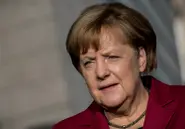
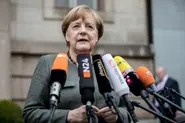
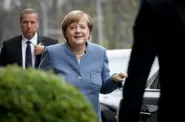
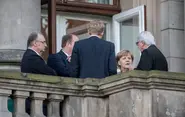
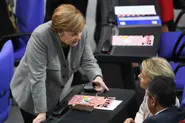
Chancellor Angela Merkel warned Friday that Germany's top parties still had several "very serious differences" to bridge ahead of next week's deadline for sealing a coalition deal.
Chancellor Angela Merkel called on Friday for a quick end to the last stretch of tortuous negotiations to forge a government for Germany, in a race against time to stop her power slipping away at home
and abroad.
Germany's divided Social Democrats will hold a crunch vote on Sunday on whether to pursue a coalition deal with Chancellor Angela Merkel's conservatives, or plunge the nation into political turmoil.
Chancellor Angela Merkel and the centre-left Social Democrats (SPD) agreed Wednesday to hold week-long exploratory talks until a January 12th deadline on forming a coalition government in coming months.
The Social Democrats, Germany's second strongest party, agreed on Thursday to kick off exploratory talks with Chancellor Angela Merkel's conservatives that could lead to a new coalition
government early next year.
The Social Democrats were initially against forming a coalition with Merkel after a historically low election result. But now they are in talks on a Grand Coalition. Will it happen?
Chancellor Angela Merkel will hold first talks Thursday with Social Democrat chief Martin Schulz hoping to end Germany's political stalemate, but the atmosphere is poisoned by disobedience within her ranks.
Chancellor Angela Merkel's conservatives and the Social Democrats geared up Monday for talks on renewing their alliance, as Germany's veteran leader warned time is pressing as Europe faces a slew of challenges.
Germany moved a step towards resolving its political crisis Friday when the Social Democrats (SPD) said they were ready to hold talks with caretaker Chancellor Angela Merkel, in a sign they might offer the veteran leader their key support.
Pressure mounted Wednesday on Germany's Social Democrat leader Martin Schulz to reconsider an alliance with Chancellor Angela Merkel's conservatives and stop Europe's biggest economy from sinking into months of paralysis.
The political crisis in Berlin challenges the idea of "German exceptionalism" as an anchor of democratic stability and a bulwark against a wave of populism, analysts said on Tuesday.
German President Frank-Walter Steinmeier, whose role rarely goes beyond ribbon-cutting, has become the man of the hour in the current political crisis, holding the key to a possible compromise or snap elections.
Chancellor Angela Merkel said on Monday that she was ready to lead her party into snap elections rather than risk leading an unstable minority government, after the collapse of coalition talks plunged Germany into a political crisis.
In Germany’s biggest political upset in years, FDP liberals walked out on coalition talks with Chancellor Angela Merkel’s conservatives and the Greens. So what is Merkel’s next move? We take a look at the possible scenarios.
Chancellor Angela Merkel was scrambling to drag Germany out of crisis on Monday after high-stakes talks to form a new government collapsed, potentially forcing Europe's top economy into snap
elections.
A collapse of exploratory talks on forming a new German government under Chancellor Angela Merkel would likely trigger snap elections, a prospect fraught with risk for Europe's top economic power.
Tough talks to form Germany's next government went into overtime Friday, putting Chancellor Angela Merkel's political future in the balance as failure to produce a deal could force snap elections.
Chancellor Angela Merkel warned that "serious differences" remain between the parties hoping to form Germany's next government but voiced hope a deal would emerge on Thursday, hours before a deadline that could trigger snap polls.
There are only two days left for the parties trying to forge a new German government to agree in principle on a set of policies for the next four years. If they can’t, Germany faces the prospect of new elections.
With coalition talks bogged down in a war of words between the negotiating parties, a senior member of the Christian Democrats (CDU) has warned that failure is not an option.
German Chancellor Angela Merkel and other party leaders vowed on Friday to push on with thorny coalition talks and refrain from personal insults, despite deep differences on hot-button issues from immigration to climate change.
Threats, name-calling and a whole lot of dramatic posturing: talks among four fractious parties to form a new government under German Chancellor Angela Merkel have proved more fiery than
fruitful so far.
The parties hoping to form a Jamaica coalition are meeting on Thursday to discuss the crucial issue of climate policy. And the negotiator for Angela Merkel’s CDU is already warning that the talks could collapse.