
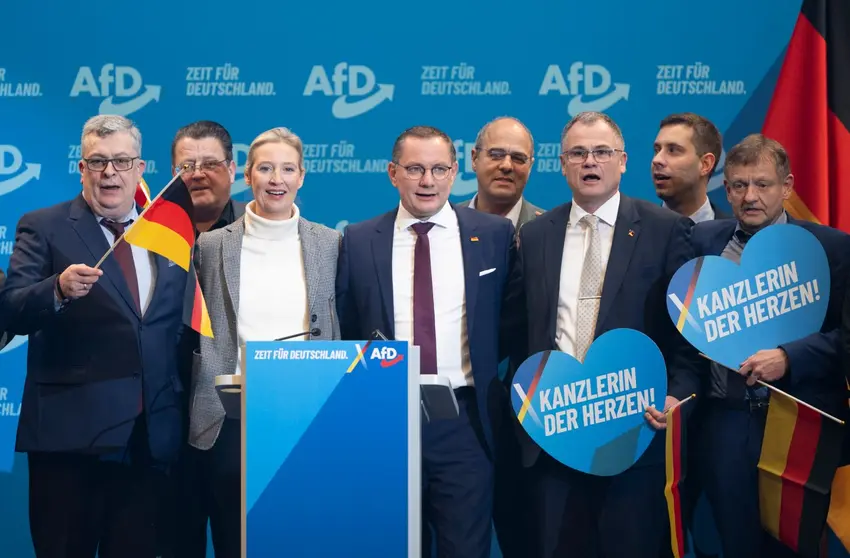
The anti-immigration Alternative for Germany (AfD) party appears to have won the second largest share of votes in the federal election.
As of 7:30pm on Sunday the 23rd, the latest voter exit polls show the far right party having won roughly 20 percent of the vote overall - which is up nearly ten percent compared to their result in Germany's last federal election in 2021. The party has roughly doubled its result since then.
The AfD's victory should not come as a surprise to anyone who has been following political news, as the party has been polling around 20 percent for weeks.
Now, however, there can be no doubt that the AfD has won the support of about one in five German voters across the country - bested only by the conservative Union party which has won almost 29 percent of the vote.
The AfD has a comfortable lead over established government parties like Chancellor Olaf Scholz's Social Democrats (around 16 percent) and the Greens (around 13 percent).
The AfD's recent rise in popularity has left some foreigners in Germany concerned about it winning power or entering government.
Historically, the Brandmauer or "firewall", which is essentially a pact among German political parties to not work with far-right extremist parties, has prevented the AfD from taking an active role within a governing coalition.
The strength of the firewall has come into question recently, after the Union's Chancellor candidate, Friedrich Merz, introduced a proposal to tighten migration policy that won with votes from both Union and the AfD.
The AfD's strong showing on February 23rd can be expected to affect German politics and the country's attitude to foreigners - which could translate into some policy changes on immigration policy in particular.
READ ALSO: German Word of the Day: Brandmauer
Is the AfD really far-right? What does it actually want to do?
The AfD recently endorsed the controversial term 'remigration' as part of its 2025 election manifesto.
This is after having publicly distanced itself from the term only last year, after news got out that some of its members had attended a summit of far-right activists in late 2023 that discussed 'remigration' and mass deportations.
In some circles, 'remigration' can mean the deportation of 'non-assimilated' foreigners who have German citizenship.
Following the news breaking, French far-right leader Marine Le Pen even threw the AfD out of her group in the European Parliament for being too extreme.
Its leader in the state of Thuringia, Björn Höcke, has been fined twice for using Nazi slogans and came out with w book in 2018 calling for a 'large-scale remigration project'.
READ ALSO: Remigration - what is the AfD's 'mass deportation' German election policy'?

The party wants to end German support for Ukraine, has questioned German membership of NATO, and wants to re-establish trade ties to Russia. Two of its European election candidates were investigated for taking bribes from Russia.
"The AfD is on a trajectory of permanent radicalisation. Three of its state chapters are already classified as right-wing extremist," Kai Arzheimer, a Mainz University political scientist who specialises in the European far-right, tells The Local.
Arzheimer is referring to designations issued by the Federal Office for the Protection of the Constitution, which investigates left and right-wing extremist groups in Germany, noting that the Office is likely to come to the same conclusion in its next report.
"In a more rational environment, politicians would consider initiating the procedure that could lead to a ban. But democrats are panicking," says Arzheimer.
READ ALSO: EXPLAINED: Could the far-right AfD be banned in Germany?
Will the AfD influence policy? How?
All mainstream political parties in Germany rule out formally working with the AfD. The CDU's own party constitution even forbids governing in coalition with the AfD.
In order to govern with such a Brandmauer in place, the AfD would need to secure an absolute majority in the Bundestag.
Germany's proportional voting system makes this exceedingly difficult, with the Federal Republic having seen only one absolute majority in its history - under CDU Chancellor Konrad Adenauer in the early 1960s.
Determined to bring her party past the firewall, AfD leader, Alice Weidel, extended an offer to join the CDU/CSU in a coalition government on an ARD broadcast on Sunday evening.
READ ALSO: What foreigners in Germany should know about the voting system
The Brandmauer traditionally extended beyond a common pledge among Germany's parties to keep the AfD out of government: Even relying on AfD votes to pass legislation was considered taboo.
But Merz showed that he was willing to break that taboo with his last push to tighten migration policies that the AfD supported.
READ ALSO: 'Shocking' - Voters in Germany react to CDU's migration crackdown plan backed by far right
With Merz now set to be Germany's next Chancellor, and the AfD set to roughly double their representation in the next Bundestag, the question now is if Merz will resort to leaning on AfD support to further tighten migration policies in future.
"Merz has tied his political survival to the Brandmauer," says Arzheimer.
But the AfD's biggest effect is its influence on overall public debate, rather than policy.
"The AfD's successes in recent elections and their strength in the surveys mean that (almost) all other parties are talking about tougher rules for immigration and even about the possible return of Syrians," says Arzheimer.
"Although there is a certain awareness that, via agenda-setting effects, this is an advantage for the AfD, (most) other parties are engaging in a race to the bottom."
READ ALSO: EXPLAINED - Could the far-right AfD ever take power in Germany?
Comments (1)