
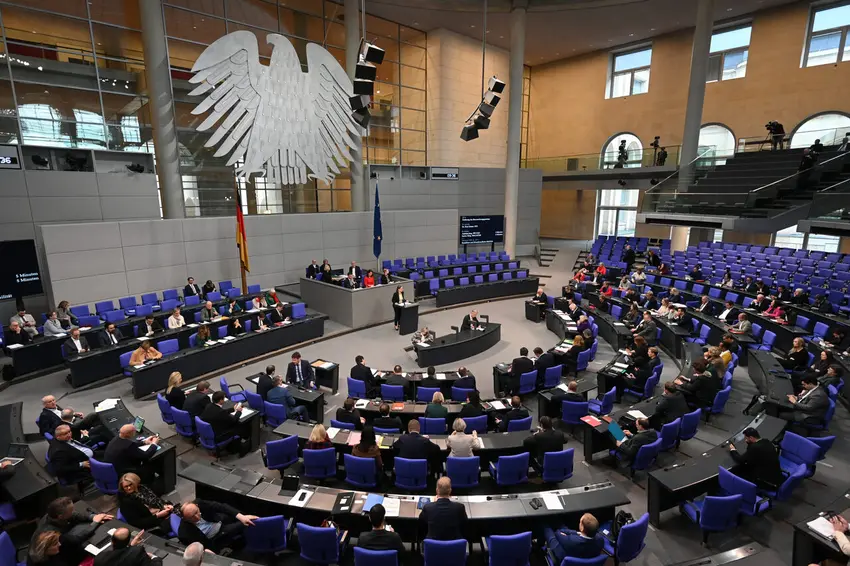
Current pre-election polls in Germany may be leaving some foreigners nervous, given what frontrunning parties have said recently on citizenship and immigration.
Christian Democrat (CDU) leader Friedrich Merz recently said dual citizenship "creates too many problems in Germany and his party has repeatedly called for repealing the recently passed citizenship reform law. The CDU is currently leading the polls at figures over over 30 percent ahead of the election on February 23rd.
In second place, with poll ratings of just over 20 percent, is the far-right Alternative for Germany (AfD), which recently endorsed 'remigration' - a policy of mass deportation.
Meanwhile, the current governing parties have seen their support collapse, with the CDU polling at roughly the same level as Olaf Scholz's Social Democrats and the Greens combined.
READ ALSO:
- CDU leader: 'Dual citizenship creates too many problems in Germany'
- Remigration: What is the AfD's 'mass deportation' German election policy
But even though these parties are leading in the polls, it doesn't mean these particular proposals are going to become law in Germany. The reason for that has a lot to do with how Germany votes and distributes seats in the Bundestag - the lower house of parliament.
In many English-speaking countries like the US, UK, Canada, or Australia - the CDU's current poll ratings could be enough to give it an absolute majority - depending on how that vote was distributed. Indeed, UK Labour won a clear majority in the last British election with just 33.7 percent of the vote - which is not far off the CDU's current numbers in German polls.
But Germany doesn't use first-past-the-post. It uses a form of "mixed proportional representation" called MMP.
READ ALSO: When do I need to have my German citizenship in order to vote in the election?
How does MMP work? How does it actually show up on the ballot?
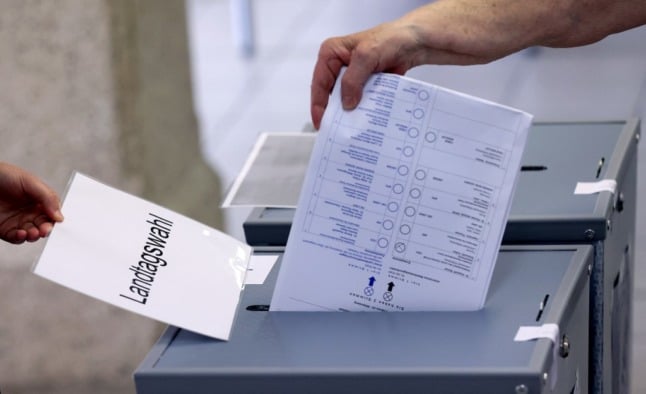
When a person votes federally in Germany, their ballot is split in half and they're given two votes.
One vote is for a candidate representing a party - just like a person voting in the UK, Canada, or Australia would vote. The winner of this ballot in a constituency wins a direct election and secures their seat - regardless of where they might be on a party list.
The second vote is a straight party vote, attached to a ranked party list.
The Bundestag must have at least 598 seats, although this number fluctuates.
That's because only half of them are decided by the direct vote of the first ballot. The second vote determines how many seats a party is entitled to.
For example, if one party wins 20 percent of seats outright but turns in 30 percent of the popular vote, they'll get their last 10 percentage points from MPs who were on the party list - with those higher up on the list going first.
On the other hand, if a party wins 30 percent of seats outright but they only get 25 percent of the vote, the Bundestag will increase in size through "overhang" seats - to help bring the number of seats a party has roughly in proportion with the party's popular vote.
The Union - consisting of the CDU and its Bavarian sister party the Christian Social Union (CSU) - has a commanding poll lead, but Germany's voting system would leave it with only about a third of seats on current numbers.
It would thus need a coalition partner to agree to repeal the current government's citizenship and immigration reforms.
READ ALSO: FACT CHECK: Can Germany's CDU scrap the dual nationality law?
Could a party get an absolute majority?
Most probably not.
Only one government in the history of Germany's Federal Republic has ever held an absolute majority. That one was under CDU Chancellor Konrad Adenauer in the 1960s.
Under current polling, no party is close to the number that would be needed.
Foreigners in Germany may well have heard about the controversial suggestion that the CDU cooperate with the far-right Alternative for Germany (AfD).
However, the CDU's party constitution expressly forbids cooperation with both the Left (Die Linke) and the AfD. Senior party figures have also flatly rejected it, and most experts say it is an out-of-the-question suggestion that would be unpopular even within the CDU and among its voters.
All other parties hold working with the AfD to be taboo and maintain a Brandmauer - or "firewall" - against it.
READ ALSO: German Word of the Day: Brandmauer
As no other party will work with it, the AfD would need an absolute majority in Germany to govern - something it's nowhere near getting federally.
With cooperation with the AfD ruled out, the CDU will need at least one of the traffic light parties to form a stable governing coalition. Even if the CDU attempts to govern with a minority government - something that would be unprecedented in Germany - it would not be able to pass or repeal anything in parliament without agreement from at least one traffic light party. The firewall against working with the AfD in Germany also extends to relying on AfD votes.
Germany's voting system thus means a CDU government would need agreement from the same parties that just passed citizenship and immigration reforms. So far, none of them seem keen to renegotiate dual citizenship or skilled immigration reform - even if they might be open to talks on tightening asylum law - for example.
Politicians who worked on citizenship and immigration reform have previously told The Local they will not help the CDU repeal the reforms they helped pass.
Germany's voting system is set up in such a way that these politicians would have to break that promise in order for this government's citizenship and immigration reforms to be repealed.
READ ALSO: Will Germany's dual citizenship law remain after new elections?
Comments