
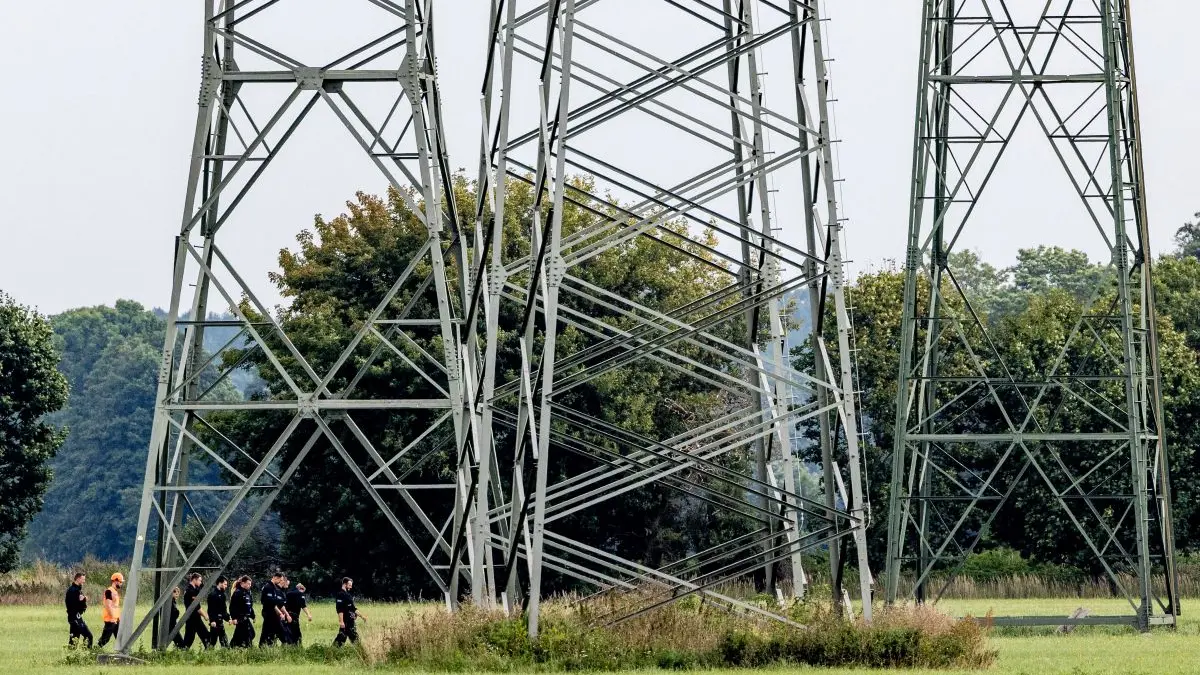
Arson attacks on power lines, at energy plants and construction sites, an explosion in a central train station; all of which just days after the federal interior and foreign ministers formally acknowledged that Germany is a "daily target of hybrid warfare".
This week the front pages of German newspapers have been covered in back to back incidents that look like acts of sabotage or ‘hybrid’ attacks.
Here’s a look at the main incidents reported across Germany this week – what we know so far, and what we don’t, as tensions between Germany and Russia rise to a level not seen since the Cold War.
This week in brief:
On Tuesday German authorities formally blamed Russia for an attempted hybrid attack involving an explosive-laden drone at the Leipzig/Halle airport last month.
Citing evidence uncovered by an official investigation, Interior Minister Alexander Dobrindt said, "the government concludes that Russia is responsible for the hybrid attack in Leipzig on August 4th".
He added that the attack was not an isolated case, but part of an ongoing series of hybrid attacks orchestrated by Russia and carried out by "low-level agents".
"We are not at war, but we are a daily target of hybrid warfare," Dobrindt concluded.
This was a significant step for Germany, which had previously avoided putting the blame on Russia for similar drone incursions and attacks on infrastructure in recent months and years. In some cases German leaders, including Dobrindt, had suggested that “foreign powers” could be behind certain incidents, but stopped short of naming Russia explicitly.
Foreign minister Johann Wadephul said that Germany would be tightening entry controls for Russian nationals, closing the Russian consulate in Bonn and cancelling the contract for the Russian House cultural centre in Berlin.
For its part, Russia called the accusations "absurd" and warned of "consequences".
On the same day improvised explosive devices were used in what looked like an arson attack on the Jänschwalde coal-fire power plant in Brandenburg.
A second incident promptly followed, in Bergheim, North-Rhine Westphalia, where perpetrators targeted overhead power lines.
In both cases, major power outages were avoided, but incendiary devices and conductive material were collected at the scenes.
READ ALSO: Just how vulnerable is Germany’s infrastructure to attacks and sabotage?
Early on Wednesday morning there was an explosion in a passageway in Augsburg's central train station. Two people suffered blast trauma and railway traffic was disrupted for several hours while police closed off the crime scene and investigated a suspicious package nearby.
Then on Thursday an arson attack was carried out on a construction site in Munich. The investigation was escalated up to Bavaria’s State Criminal Police Office (LKA), after it was found to have likely been aimed at the office of a defence firm.
As of Friday morning, more incidents are being investigated in NRW, where police suspect further sabotage attempts had been made on energy substations in Dormhagen and near Aachen in Weisweiler. A device was reportedly found at the former site, although no damage was reported. Police received a letter claiming responsibility for a crime at the latter.
Also in Berlin, terminal 1 at BER airport was evacuated for several hours from Thursday into Friday after a woman told police there that she had a dangerous substance in her bag. Authorities have not yet said if they were treating the case as an act of sabotage. As of Friday morning a police spokesman said they were "still in the process of evaluation."
Hundreds of cases
The above incidents are only the latest in a long-series of cases of suspected hybrid attacks.
A recent report by Süddeutsche Zeitung, NDR and WDR, revealed that federal and state security authorities have registered 165 suspected cases of sabotage so far in 2026 – most of them occurring in Lower Saxony, North Rhine-Westphalia and Bavaria.
The figures come from analysis by the Federal Criminal Police (BKA).
Last year, there were a total of 320 suspected cases.
READ ALSO: German-Russian jailed for six years in Munich sabotage trial
What we know and what we don’t
Remarking on the case at Bergheim, North Rhine-Westphalia’s Interior Minister Herbert Reul said that "more sabotage, more hybrid attacks [are] happening right on our doorstep."
He added, "Anyone who acts this way is not just trying to hit cables; they're trying to hit our country."
Russia has a clear motive to attack Germany, which has been Ukraine’s biggest military backer since the end of 2025. But being caught committing a direct attack against Germany also risks triggering a huge escalation, potentially sparking war with NATO.
The attacks seen in Germany so far fall below the threshold of open warfare, but have included drone flights near sensitive sites, airspace violations, cyberattacks and suspected assassination plots. Russia denies involvement in any of them.
Specifically regarding the drone attack on Leipzig airport, German authorities have named two suspects – both of whom have Russian passports – citing DNA evidence found on objects left at the scene.
Excepting that case, German authorities have not yet drawn conclusions about who is behind the other incidents listed above. Investigations can take weeks or months.
A major challenge is that hybrid attacks are intentionally difficult to identify and track. They can be carried out by individuals recruited online and paid for via anonymous channels.
Andrei Soldatov, a London-based expert on Russian security services, told AFP that the Western toolbox for responding to Russia's escalations was outdated.
"We need to accept that we are facing a long hybrid war," he said. "In this war, solutions devised during the Cold War will not work, nor will ideas developed over the past decade prove effective."
Beyond Germany, intelligence agencies in Denmark and France have also raised the alarm about sabotage incidents in their countries.
Comments