
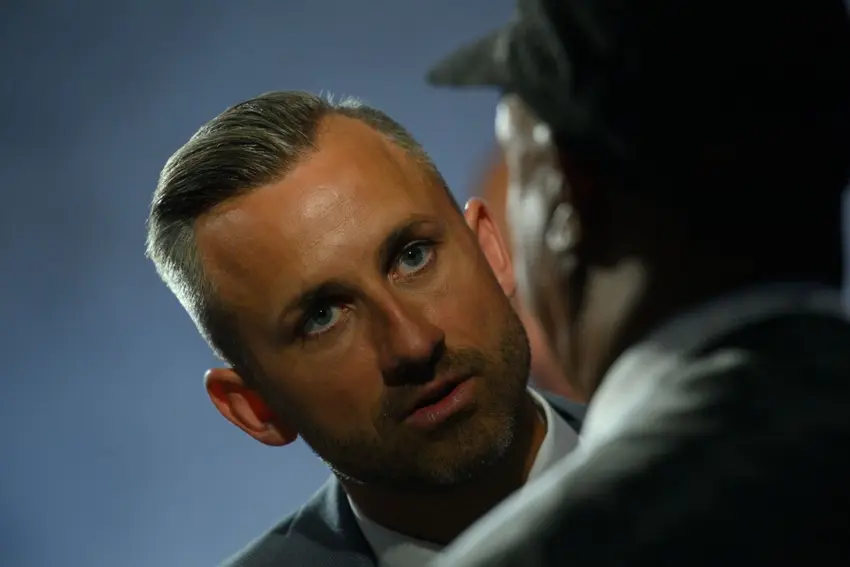
The Alternative for Germany (AfD) is polling at over 40 percent ahead of state elections on September 6th -- roughly 20 percentage points ahead of the conservative Christian Democrats (CDU) in second place.
Some people might assume that even if the AfD wins the most votes in the election, Germany’s firewall (Brandmauer) against cooperation with the far-right party would prevent it from entering government. But events in recent days suggest that assumption may be increasingly risky.
The debate over whether parts of the Bündnis Sahra Wagenknecht (BSW) could help weaken or circumvent that firewall has intensified, while AfD leaders say their goal is to win enough votes to govern alone.
Were that to happen, it would mark the first time that a far-right party (officially classified as extremist in the state of Saxony-Anhalt) took the reigns of the head of a German state government since the founding of the Federal Republic.
READ ALSO: Germany's CDU slammed for 'empowering AfD' with plan for deportation centres
Who is Ulrich Siegmund?
The AfD has been building support in Saxony-Anhalt for years, but the scale of support for the anti-immigration party in this election is closely connected to the popularity of its lead candidate.
Ulrich Siegmund, 36, grew up in Tangermünde, Saxony-Anhalt.
A former CDU member, he joined the AfD during the eurozone crisis and entered Saxony-Anhalt's state parliament in 2016.
His rise within the party accelerated during the Covid-19 pandemic. As the AfD's health policy spokesman in the state parliament, Siegmund built a large online following through videos attacking what he described as pandemic "scaremongering" and questioning the actions of political institutions and parts of the media.
State broadcaster MDR describes him as a disciplined communicator who carefully controls his public image.
And that public image has arguably become a major part of the AfD's success in Saxony-Anhalt. While many Germans still associate the AfD with angry rhetoric, Siegmund typically presents himself with smiles, handshakes and carefully crafted social media videos. On Tik-tok he speaks to 700,000 followers.
He has a reputation for remembering names, chatting easily with strangers and making voters feel seen.

Siegmund's campaign events are professionally staged and amplified by a network of sympathetic online influencers and YouTubers. He is frequently shown surrounded by admirers in T-shirts bearing his face or chanting a shortened form of his name: "Uli, Uli, Uli".
But controversy has followed him throughout his rise to prominence. The headline of a feature story on him, which made the cover of Der Spiegel magazine this week, called him "the most dangerous man in Germany".
Siegmund took part in the 2023 Potsdam meeting that attracted national attention because of its links to discussions around "remigration". The meeting became one of the biggest political scandals in modern German politics after reports emerged that participants had discussed plans linked to mass expulsions and the removal of people with migrant backgrounds from Germany.
Siegmund was also criticised for his part in hiring a former activist from the Identitarian Movement, which advocates for the creation of an ethnically and culturally homogeneous state. He defended his recommendation by saying he does not carry out "ideological vetting" but the case is hardly an isolated one.
READ ALSO: Election guide - Germany's main political parties explained
According to Spiegel reporting, several people now working in Siegmund's political orbit have backgrounds in extremist organisations. Among them are former members of the Heimattreue Deutsche Jugend (HDJ), a neo-Nazi youth organisation that was banned in Germany in 2009 because of its ideological links to National Socialism.
One of Siegmund's closest advisers, Patrick Harr, previously held a leadership role in the HDJ. Another, lawyer Laurens Nothdurft, was one of the organisation's most senior figures. Both are now considered influential figures within the AfD's Saxony-Anhalt operation.
What would an AfD government do?
The AfD's 100-day program for Saxony-Anhalt calls for deportations "from minute one", expanding deportation detention facilities and creating special classes for migrant children.
The programme also calls for the removal of rainbow flags from schools, the promotion of German national symbols and the creation of a parliamentary committee to investigate coronavirus-era policies.
At the 2023 meeting in Potsdam, revealed by Correctiv, Siegmund was reported as pitching his 'master plan' for Saxony-Anhalt as follows: "The street scene must change...Foreign restaurants must be put under pressure. Living in Saxony-Anhalt should be as unattractive as possible for this clientele [foreigners]".
READ ALSO: 'Welcome culture to farewell culture' - The AfD's plans for Saxony-Anhalt
Comments