
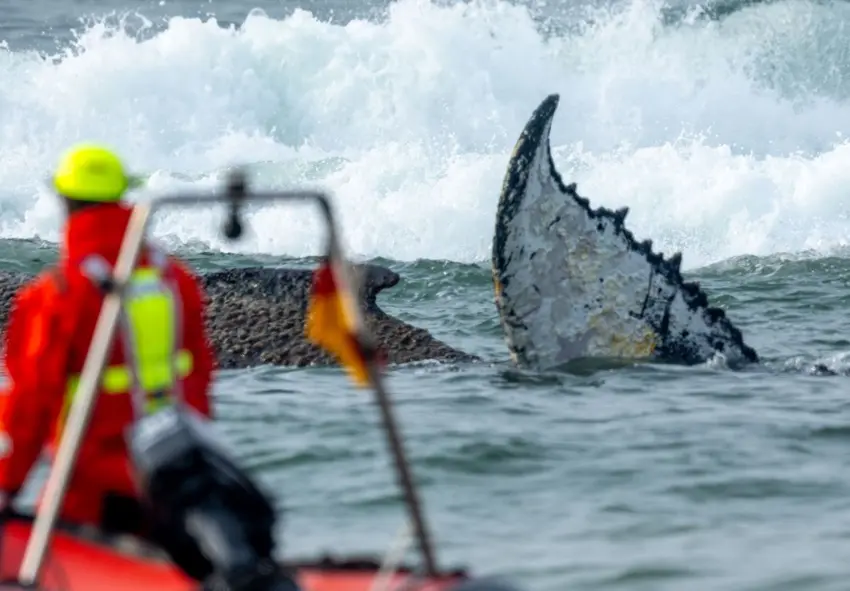
Tuesday's top story: Rescue efforts underway to free humpback whale from Baltic coast
Efforts to rescue a humpback whale stranded on a sandbank near Niendorf, on Germany’s Baltic Sea coast, have so far proved unsuccessful, with experts warning that the animal’s condition is deteriorating.
The young whale, believed to be a migrating male, was discovered early on Monday after hotel staff reported unusual noises coming from the shoreline.
Rescuers made renewed attempts overnight to help the ten‑metre‑long animal back into deeper water, but the higher tides were insufficient to allow it to free itself. Boats from the coastguard, fire brigade and conservation group Sea Shepherd tried to generate waves to guide the whale towards a shipping channel, without success.
Experts from the Institute for Terrestrial and Aquatic Wildlife Research said the whale appears exhausted and may be suffering from a skin condition linked to the Baltic Sea’s low salinity. Fragments of fishing net were found wrapped around its body, which may have contributed to the stranding.
Authorities have cordoned off the beach to minimise stress on the animal, urging the public to keep their distance. Environmental officials said further steps were being discussed.
SPD leadership tries to hang on after another state election let down
After another loss at the state level, this time conceding the state ministership in Rhineland-Palatinate for the first time in 35 years, leaders of the Social Democratic Party (SPD) said they didn't plan to resign from their posts.
"We will not plunge the second-largest governing party into chaos now," said Vice-Chancellor Klingbeil in Berlin on Monday.
Now eyes will be on how the party move forwards in its relationship with Germany's conservative Union parties (CDU/CSU) at the federal level.
READ ALSO: Merz cheers victory in Rhineland-Palatinate as Social Democrats mourn 'catastrophic' result
The SPD wants to focus on social reforms on Friday at a large meeting of leading federal, state and local politicians.
Klingbeil has been calling for an income tax reform to noticeably relieve people earning 3,000 euros or less per month. Meanwhile Bas has addressed the government commissions on care, health care and pensions.
Meanwhile, Chancellor Friedrich Merz (CDU) made it clear that he did not want to rush anything: "We are not making hasty decisions here. We are in a work rhythm and we are continuing it."
The CDU in Rhineland-Palatinate and its top candidate Gordon Schnieder won comfortably on Sunday against the SPD. It is the second crushing defeat of the Social Democrats in two weeks, after they almost flew out of the state parliament in Baden-Württemberg with just 5.5 percent.
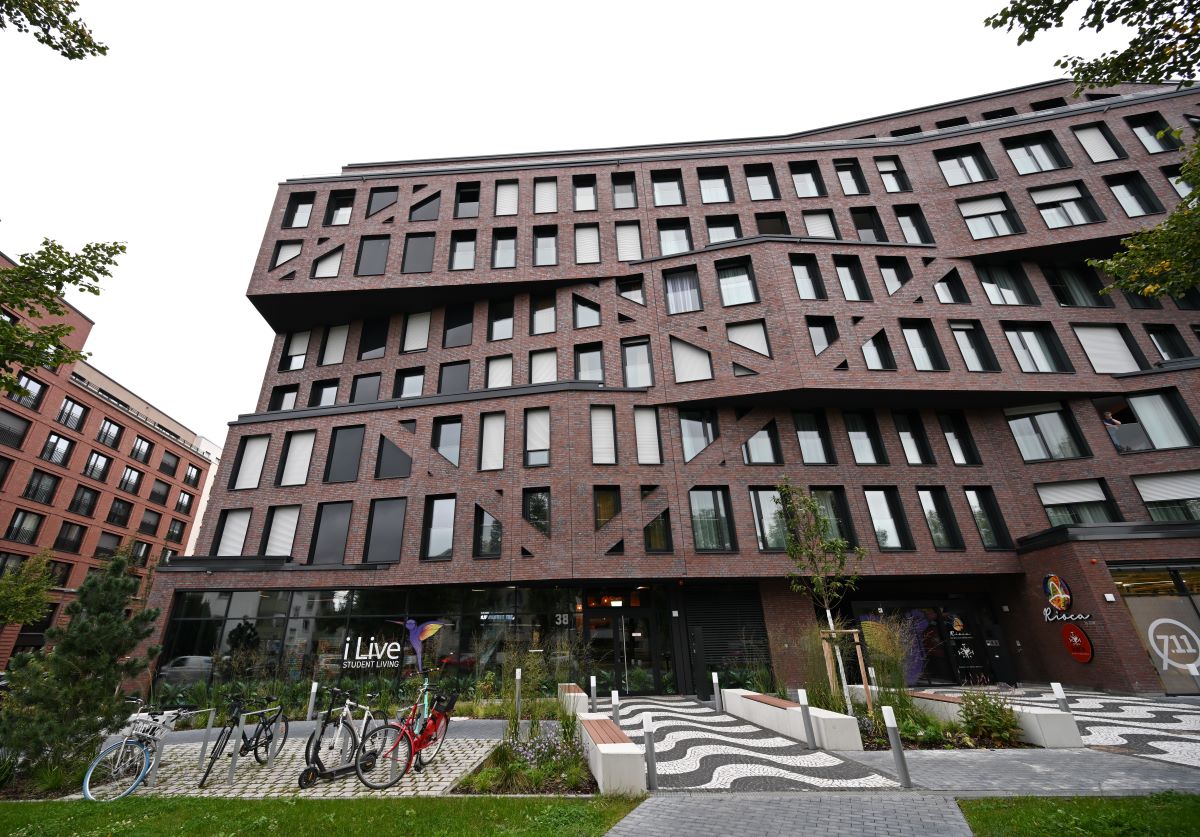
Student housing costs continue to outpace inflation across Germany
Housing costs for students in Germany continued to rise faster than inflation in 2025, adding to mounting pressure on those studying in major university cities.
The average monthly rent for a room in a shared flat increased by 3.9 percent last year to €512, according to new analysis by the Moses Mendelssohn Institute.
While the pace of rent increases has slowed compared with previous years, researchers warned that prices remain at a very high level.
READ ALSO: Which German cities are the most expensive for international students?
“The situation is becoming more difficult for many people searching for housing,” said institute director Stefan Brauckmann.
Costs vary sharply by location. Students in Munich face average rents of around €800 per month, while prices in Berlin and Hamburg have risen to about €650.
Cologne and other large cities have also seen steady increases. Although an east‑west divide persists, it is slowly narrowing.
The study found that the current BAföG housing allowance of €380 falls well short of covering average rents, even with a planned increase to €440. Student representatives have urged the federal government to act swiftly, warning that the shortage of affordable housing has become an existential issue for many students.
Number of young people in foster homes is growing
The number of young people living in homes or with foster families has risen for two years in a row.
In 2024, about 221,500 young people lived outside their own families at least some of the time, according to Germany's statistics office. That is around three percent more than in 2023. From 2022 to 2023, the number had increased by around four percent.
Nearly half (47 percent) of those affected come from single parent homes.
READ ALSO: What to know about dealing with domestic violence in Germany
According to the statistics office, the most common reason (at 19 percent) for admission to a home or foster family in 2024 was the "absence of the caregiver". In some cases this happens when a minor comes to Germany without parents, or if a child's singular parent fell ill.
In second place at 15 percent was a "limited parenting competence", i.e. excessive demands or insecurities on the part of the parents.
The third most common reason was the endangerment of the child's welfare through neglect, abuse or sexual violence in 13 percent of cases, it said.
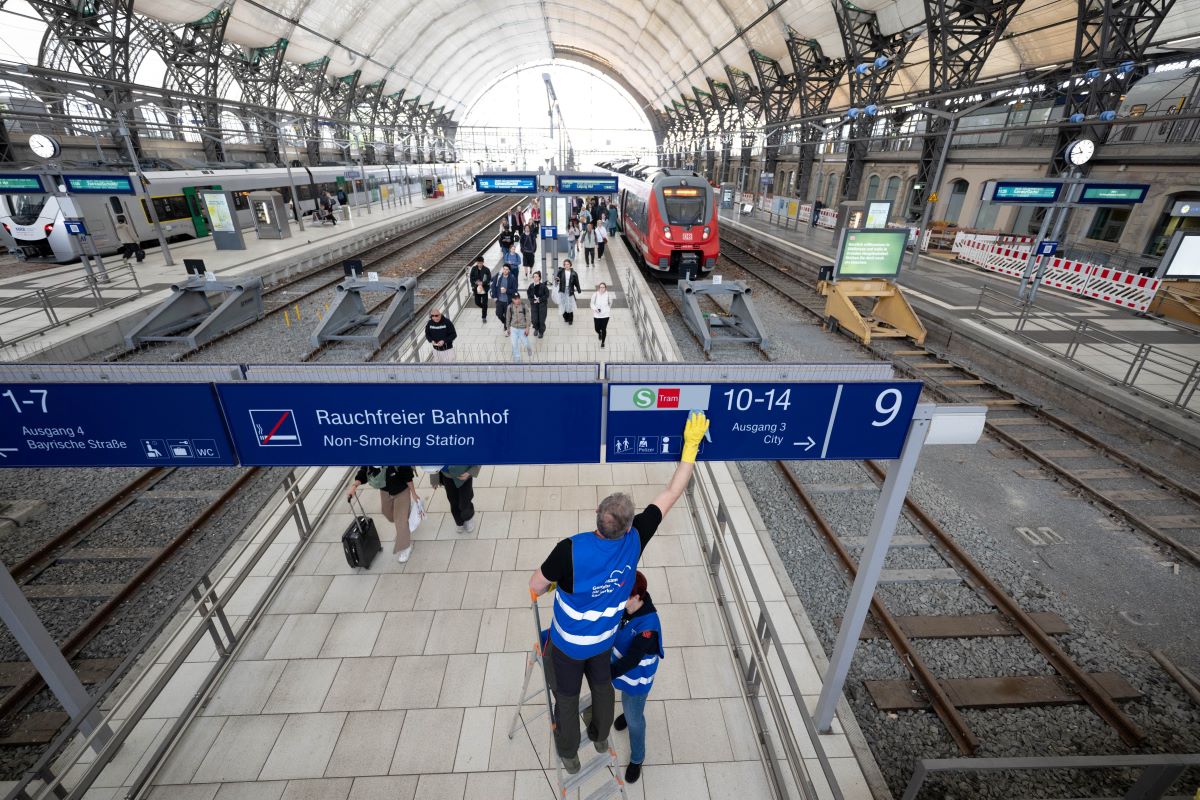
Deutsche Bahn begins spring cleaning at 1,400 stations
Deutsche Bahn begun its annual spring-cleaning programme (Frühjahrsputz) on Monday at more than 1,400 train stations across Germany, doubling the number covered last year.
Hundreds of staff will spend the coming weeks cleaning platforms, stairways, tunnels, lifts, ticket machines and public areas, with the campaign due to run until the end of May.
READ ALSO: Deutsche Bahn plans to improve comfort now and punctuality later
Although the initiative is annual, this year it also forms part of an emergency programme launched in January aimed at improving safety and cleanliness at stations. Local authorities in several cities, including Hamburg, Essen and Ulm, are also cleaning areas around stations at the same time.
Alongside cleaning, Deutsche Bahn plans to increase security staff at selected locations, install additional cameras in cooperation with federal police and deploy mobile repair teams. The company says it will invest an extra €50 million this year in station safety and cleanliness.
With reporting by AFP, DPA and Paul Krantz.
Comments