
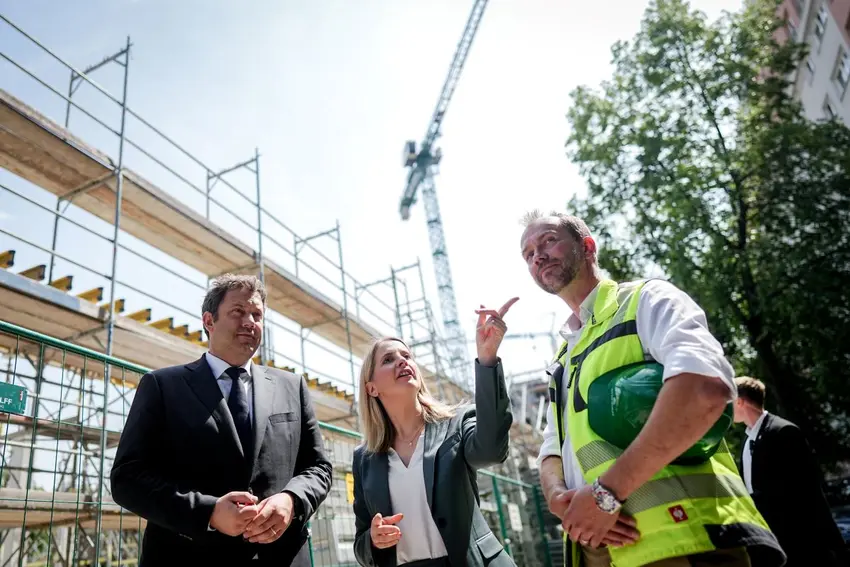
A new draft law, referred to as Bau-Turbo (Construction-turbo), which is designed to speed up residential construction in Germany, was approved on Friday by the Bundesrat.
Designed to encourage "densification", the law is intended to permit a more flexible approach to delivering new housing. Bringing forward this change had been introduced months ago in the coalition agreement between the CDU/CSU and the SPD.
The law’s swift approval by the Bundesrat, following passage through the Bundestag on October 9th, reflects political consensus on the urgent need to simplify and accelerate housing development through the easing urban planning rules.
How will the new law work?
The legislation removes a number of legal and bureaucratic barriers that delay projects, allowing municipalities to approve new housing developments much faster – potentially within a three-month review period instead of the standard five years.
This significant reduction in approval time was praised by Construction Minister Verena Hubertz of the centre-left Social Democrats (SPD).
Hubertz, a former start-up founder, emphasised at an online conference with hundreds of municipalities that the plan focuses on smarter urban space use and reducing construction costs.
READ ALSO: German apartments are getting bigger despite the housing crunch
The law includes an “experimentation clause,” valid until the end of 2030, which is intended to allow cities to deviate from current planning rules and test faster building approvals without drafting or changing detailed land-use plans.
The law also encourages using vacant inner-city land and adapting existing buildings rather than developing greenfield sites at city edges.
During the online conference, Hubertz suggested that examples might include adding extra floors on supermarket roofs or raising permitted building heights in Berlin.
The law is also intended to balance faster construction with environmental and aesthetic concerns.
Hubertz underscored the need to avoid low-quality developments, citing mass-produced Plattenbau buildings as an example to avoid.
In addition, future provisions will allow more flexibility when it comes to protecting residents from construction noise, including the use of walls, shrubs, or soundproofing methods.
The government assures that environmental protection will continue to be important. Projects will still have to avoid negatively impacting rare animals or plants, and nature conservation authorities will continue to assess relevant biotopes and the environmental compatibility of developments.
READ ALSO: Berlin issues first ever fine against landlord for overcharging on rent
Nonetheless, the Ministry of Construction has indicated that it expects this process to be accelerated along with other procedures.
How has the new law been received?
Sebastian Dullien from the Hans Böckler Foundation warned that high construction costs remain a challenge.
According to estimates, Germany needs to build around 320,000 homes annually to meet demand – far above current approvals.
Tim-Oliver Müller of the German Construction Industry Association supports the law but insists that further subsidies and deregulation are needed to truly unlock the sector's potential.
With reporting by DPA.
Comments (1)