
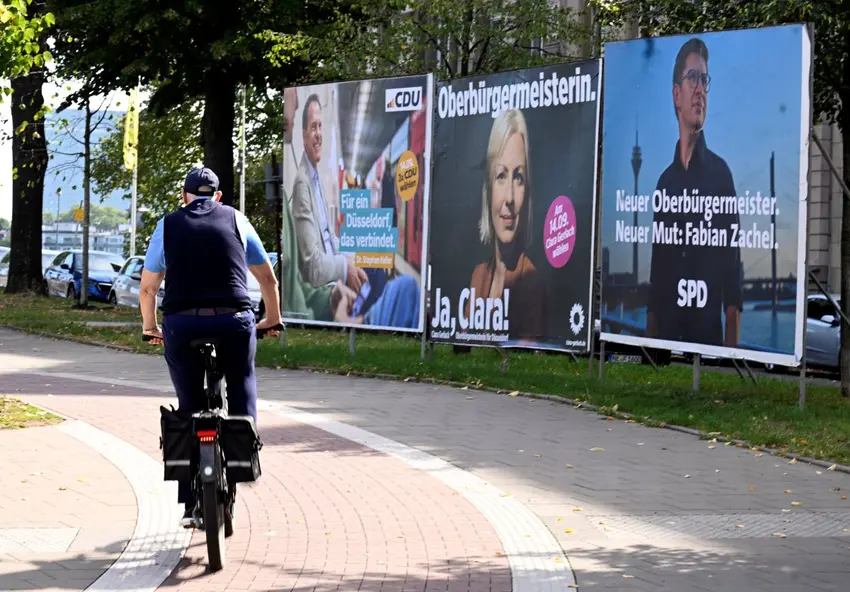
On Sunday, September 14th, voters in North Rhine-Westphalia (NRW) will head to the polls in what could turn out to be a series of nail-biting municipal elections. Polls show many of the races are incredibly close.
And, unlike in federal elections, some foreign residents in Germany can also cast a vote and have a say in how their local towns and cities are run.
Who can vote in the municipal elections?
In addition to German citizens, all nationals of other EU member states who are at least 16 years old on election day can vote, providing they have been living in the relevant municipality for at least 16 days before the election.
On voting day, remember to take your election notification card (Wahlbenachrichtigung) and a valid form of photo ID with you to your polling station.
Where can I vote?
If you're unsure where to vote, the easiest way to find out is to check the notification card sent to you in the mail or consult your local municipal website, which will list polling locations based on your address. Many cities in NRW also provide online search tools to find polling stations quickly.
READ ALSO: 'Germany is on the right track' - Meet the Indian dentist who aspires to join the Bundestag
Why should I vote?
Municipal elections, or Kommunalwahlen, elect representatives to local city councils, district parliaments, and more importantly, mayors and district administrators.
These officials oversee areas deeply connected to daily life, including; school policies, urban planning, public transport, social welfare, cultural programs, policing, and integration efforts.
In fact, for many residents, the decisions made by local governments can have a more immediate and visible impact on their daily lives than those made at the state or federal levels.
What are the polls predicting?
There are roughly 13.7 million voters across NRW, and local surveys suggest a fierce ongoing battle for hearts and minds.
In total 18 different parties ran in the last Bundestag election from the state of NRW. The major parties with candidates running in up-coming city elections include the CDU, the SPD, the Greens, the AfD, the Left, the FDP, Volt and Die Partei.
The conservative CDU party, which currently heads Germany's federal government, seems to be holding onto their majority overall, especially in rural areas, while the SPD are expected to face losses.
The Greens appear to be dominating in urban areas but lagging in rural regions.
Notably, polls suggest the AfD could surge to 15 or 16 percent – especially in the Ruhr region – and snatch a number of traditional SPD strongholds.
In Cologne, the mayoral contest is wide open with SPD’s Torsten Burmester maintaining a narrow lead in the polls (15 percent), with the Greens’ Berivan Aymaz close behind (13 percent), and the CDU’s Markus Greitemann trailing (11 percent). Undecided voters remain high, making a runoff virtually certain.
Dortmund’s race is equally tight between SPD incumbent Thomas Westphal and independent challenger Martin Cremer, with the AfD polling in double digits.
Münster’s barometer report shows the Greens’ Tilman Fuchs ahead, setting up a possible power shift away from the CDU.
Düsseldorf remains a CDU bastion but faces a stronger than usual challenge from the Greens.
With so many municipal elections taking place on the same day in the state, many cities are already warning of shortages of election workers.
Unsure who to vote for? Try the Wahl-O-Mat
If you need help deciding who to vote for, several municipalities in NRW are offering help in the form of a bespoke Wahl-O-Mat known as the Lokal-O-Mat – an interactive online quiz which asks a series of political questions in order to help voters understand how the policies of the different parties match their views.
READ ALSO: Wahl-o-Mat - The online tool that can help you pick a party in the German elections
The main Lokal-O-Mat site has options available for ten municipalities in the state: Aachen, Coesfeld, Duisburg, Düsseldorf, Gütersloh, Haan, Köln, Krefeld, Münster, and Witten.
Other municipalities have set up their own Wahl-O-Mats, more details about which can be found here.
Polling stations on voting day will be open from 8am to 6pm on Sunday. After the polls close, preliminary results will be announced as soon as the first counts are tallied, with many key outcomes expected by about 10pm on election night.
Comments