
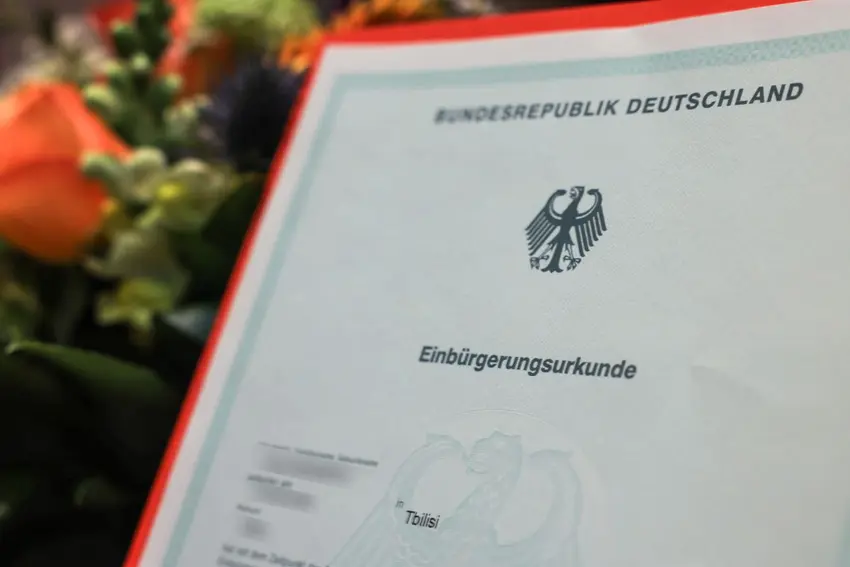
A recent report on the topic of the German naturalisation in Berlin stirred up tired political debates around dual citizenship and digitalising the citizenship application process.
Here’s a look at what’s been said versus what’s true about applying for naturalisation.
It started with a BILD article
“Now you can get your German passport at the click of a mouse” was the headline of a recent article published by the tabloid newspaper BILD.
The report highlights Berlin’s newly digitalised citizenship application process and claims that a “rapid increase in naturalizations is due to the fact that applicants are being checked in person less and less”. It points to the fact that the number of naturalisations in Berlin has increased significantly since the application process was put online.
The report sparked political controversy and stirred up old debates.
Interior Minister Alexander Dobrindt (CSU) voiced concern in response to the report. He cited a rule requiring citizenship applicants to acknowledge their commitment to Germany’s constitution and values including the protection of Jewish life, and said, “I can hardly imagine that this will work without a personal appointment”.
FACT CHECK: Do new German citizens have to affirm Israel’s right to exist?
Berlin’s Mayor Kai Wegner (CDU) also engaged, telling BILD that he had asked the city-state’s senator of the interior to clarify the citizenship process and explain how “legal requirements are guaranteed”.
How does the digital citizenship process work?
The idea, proposed by BILD, that one can easily obtain German citizenship “at the click of a mouse” is demonstrably false.
In fact, BILD’s own report includes a quote from a spokesperson for Berlin’s immigration authority (LEA) that clarifies, “A personal interview takes place after a positive application review.”
Prospective Germans in Berlin must submit their naturalisation application and required documents to an online portal, which officials then check.
This is different to many other German states where the process has not yet been digitalised. However, Berlin is not the only state to offer digital naturalisation services. In many parts of Bavaria applicants can submit their documents with the BayernPortal, and the city-state of Hamburg also has online submissions.
With the digital process, in-person interviews to determine an applicant’s German language knowledge are not necessary, for example. But applicants still need to prove their B1 level German language skills by passing an accredited language exam.
The same goes for other basic requirements for citizenship – applicants’ qualifications all need to be backed up by verifiable documents.
CHECKLIST: What do I need to apply for German citizenship under the new law?
If an application meets the requirements for German citizenship, then a final interview and ultimately a naturalisation ceremony are scheduled.
An LEA spokesman confirmed to Tagesspiegel that the digital process ensures that the same requirements are met, including “inquiries to the security authorities such as the Office for the Protection of the Constitution and the Federal Central Register...”
The spokesman pushed back on the idea that the digital process is not as careful, adding, “Rather the opposite is correct”.
Efficiency as a scandal
What was not mentioned in BILD’s report nor in the follow-up comments by Dobrindt or Wegner is that the LEA’s digitalisation of the citizenship process (as well as other applications for residence permits) came in response to a tremendous backlog of paperwork that had built up for years.
As The Local reported, the Berlin authority’s previous application process culminated in a backlog of some 40,000 applications last year – some of which in the form of physical files “locked in a warehouse in Brandenburg” according to comments by the LEA director.
READ ALSO: 'I've waited four years' - Foreigners in Berlin furious over German citizenship delays
Since Berlin’s LEA has rolled out its new digital application portal it has processed applications much more effectively, which partly explains why naturalisations in the capital city have increased significantly.
Some online applicants in Berlin have reported receiving a decision on their application within a matter of weeks. That’s significantly better than most immigration offices in Germany’s big cities, many of which report expected processing times in the range of nine months to more than two years.
Comments (1)