
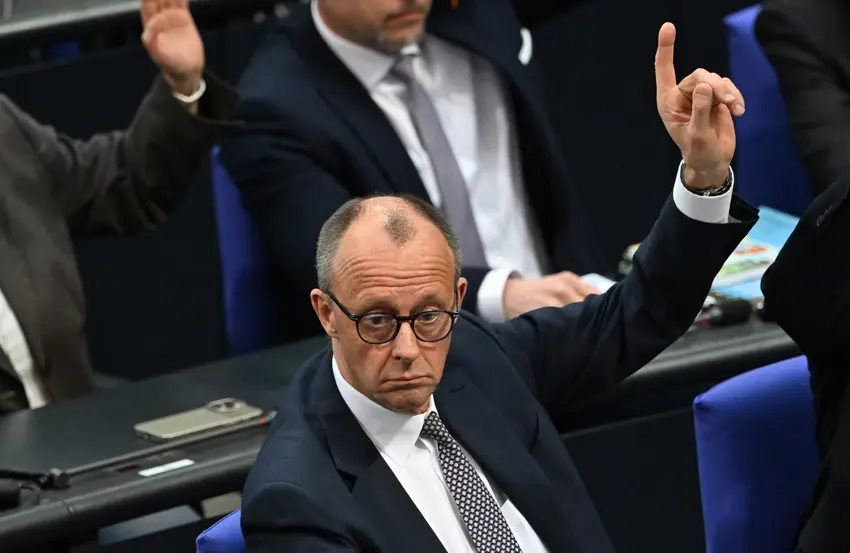
The president of the assembly, Julia Klöckner, was "preparing to convene the German Bundestag for the election of the federal chancellor... on Tuesday, May 6th", parliament said in a statement.
The date was "subject to the parties' approval of the coalition agreement" and Merz's nomination by the German federal president, the parliament said.
Both steps are expected to be a formality after Merz's conservative bloc, the CDU/CSU, and his future governing partners, the centre-left Social Democrats (SPD), settled on a roadmap for government last week.
READ ALSO: How soon will Germany's new government take office?
But the parties have showed signs of friction even before taking office.
Senior figures within the SPD have criticised Merz for casting doubt over the timeline for an increase to the minimum wage to €15 written into the coalition deal.
And with SPD members set to begin voting to approve the agreement on Tuesday, Merz caused a stir with his claim that a planned cut to income tax for lower- and middle-income earners was "not set in stone" and depended on having room in the government's budget.
The door to power was opened for Merz when Chancellor Olaf Scholz's querulous coalition between his SPD, the Greens and the pro-business FDP collapsed in November.
The disintegration of the government paved the way for elections in late February, which the CDU/CSU bloc won with 28.5 percent of the vote.
The conservatives' result nevertheless missed expectations and left them looking to Scholz's Social Democrats to build a majority in the Bundestag.
Scholz himself will take a step back from front-line politics once Merz is sworn in as his replacement.
The formation of a new government comes at a difficult moment for Germany, with the economy sputtering and its relationship with the United States, its key ally, rattled by President Donald Trump's return to office.
Trump's turbulent tariff policy and overtures to Russian President Vladimir Putin to end the war in Ukraine have thrown into doubt Germany's export-focused economic model and its historic reliance on US security guarantees.
Merz has sought to get a head-start on tackling the big issues facing Germany. After the election but before the coalition was agreed, Merz forced through changes to Germany's strict debt brake to make way for a defence and infrastructure spending boost worth hundreds of billions of euros.
KEY POINTS: How Germany's new coalition will affect your bank balance
Comments