
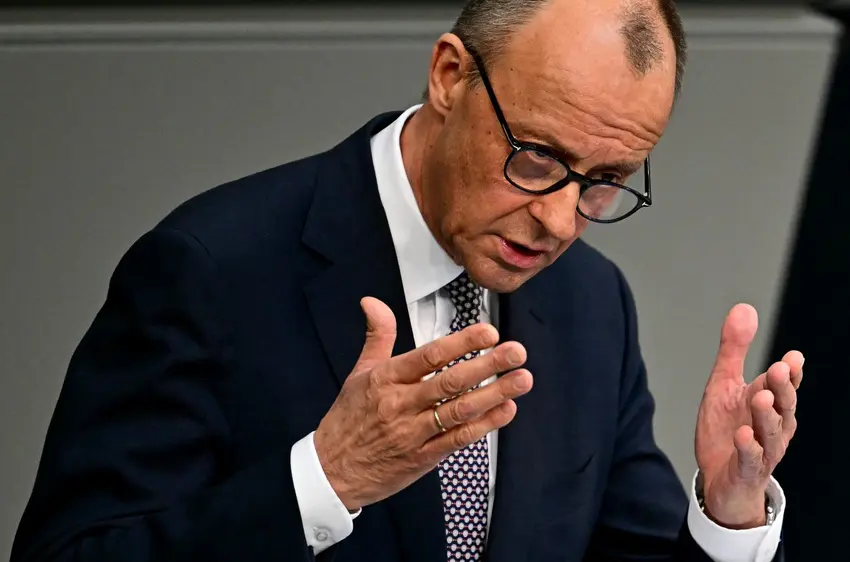
"It is a war against Europe and not just a war against the territorial integrity of Ukraine," Merz told parliament ahead of a vote on plans that also include massive new funding for infrastructure.
Merz said Russia's aggression had included cyber-attacks and espionage, arson and contract killings as well as disinformation campaigns that "attempt to divide and marginalise the European Union".
Europe today faces "an aggressive Russia" as well as "an unpredictable United States of America", said Merz, whose conservative CDU/CSU bloc won last month's general elections.
Merz's plans envisage exempting defence spending from the country's strict debt rules when it exceeds one percent of GDP and setting up a 500-billion-euro fund for infrastructure investments over 12 years.
His bloc is hoping to push the measure through the Bundestag at a time when US President Donald Trump's outreach to Russia and hostility towards Ukraine have shaken Europe and cast doubt over the future strength of transatlantic ties.
"I want to make this clear: I am in favour of us doing everything we can to uphold transatlantic cooperation," said Merz. "I consider it indispensable, but we must now do our homework in Europe.
"We must become stronger. We must ensure our own security. That is our responsibility. Germany has a leading role to play in this, and I believe we should be prepared to assume this leadership responsibility."
READ ALSO: Germany has ditched the debt brake, but what will the consequences be?
Merz said the spending boost planned for the German armed forces, expected to add up to hundreds of billions of euros in the coming years, is "nothing less than the first major step towards a new European defence community".
He said this grouping would include "countries that are not members of the European Union but are very interested in building this common European defence together with us such as... Great Britain and Norway".
Merz said new defence contracts should be awarded to European manufacturers "whenever possible".
READ ALSO: German arms firm Rheinmetall seizes on European 'era of rearmament'
"We must rebuild our defence capabilities," he told lawmakers, adding that this should be done with "automated systems, with independent European satellite surveillance, with armed drones, and with many modern defence systems" ordered from firms on the continent.
Far-right opposed
If the proposal were to fail to pass now, it would have little chance of being passed by the incoming Bundestag. The far-right and Moscow-friendly Alternative for Germany (AfD) and the far-left Die Linke parties -- which both oppose the plans -- would have the numbers needed to block them.
The deal hangs on a margin of 31 votes, wrote Der Spiegel magazine, which warned that "some departing parliamentarians could take the opportunity to get back at the new government with a no vote".
Bernd Baumann of the AfD accused Merz of ignoring the will of voters by seeking to push the vote through the old parliament.
"The new Bundestag is the legitimate one" because "it has new majorities that the people want", Baumann said, charging that Merz "wants to buy himself the chancellorship from the SPD and the Greens, like in a banana republic".
Lars Klingbeil of the SPD said that the massive new spending aims to "maintain peace in Europe" but also "invest in advancing the economy and strengthening social cohesion".
He said the massive spending, "perhaps the largest package in the history of our country" would therefore also help counter "division and polarisation".
The measures must also still be voted through the upper house of parliament (Bundesrat) on Friday, where they also require a two-thirds majority.
Coalition negotiations will then continue between the two big parties, with Merz aiming to have a government in place by Easter on April 20th or soon after.
If all goes according to plan, the new parliament will vote on whether to appoint him as chancellor on April 23rd.
TIMELINE: How soon will Germany get a new government?
Comments