
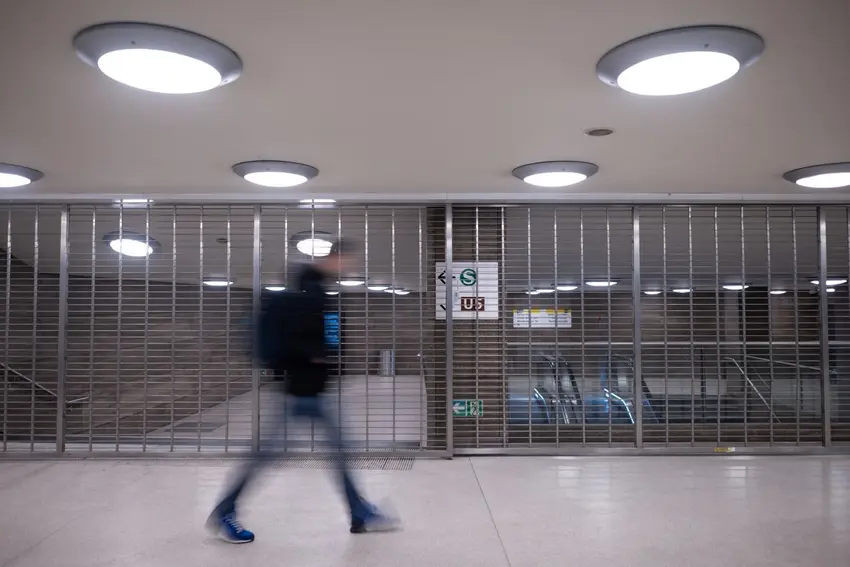
The Verdi trade union has once again called public transportation workers in Berlin to walk off the job -- this time for two days on Wednesday and Thursday (March 26th and 27th).
According to reporting by Tagesspiegel newspaper, Verdi and the BVG have said that their most recent talks were "positive" but the two-day strikes are still going forward as planned.
As in previous strikes by Berlin's transport company (BVG), U-Bahn trains and trams will not run at all during the industrial action, and the vast majority of the city's buses will be stopped as well.
This will apply from 3am on Wednesday morning until 3am on Friday in most cases, with some specific lines affected slightly before and after those times.
Which BVG buses are still running?
While U-Bahn stations will be completely closed off and trams will remain parked in their terminals, a handful of BVG-operated bus lines will remain in motion.
Tagesspiegel previously reported that these include 22 routes during the day and 12 night lines. Many of which serve neighbourhoods on the outskirts of the city -- important metro and express buses (those marked with an 'M' or 'X') will not run.
According to BVG's website the following bus lines will be in service through the strike: 106, 114, 118, 133, 161, 168, 175, 179, 204, 218, 234, 263, 275, 316, 318, 320, 326, 334, 349, 358, 363, 380, N12, N23, N35, N39, N53, N61, N63, N69, N84, N91, N95, and N97.
BVG also says that lines 112, 124, 184, 744, 893, N68 and X36 will run "with limited service."
Passengers planning to use these lines are advised to check the route for current updates on the BVG app or website before heading out.
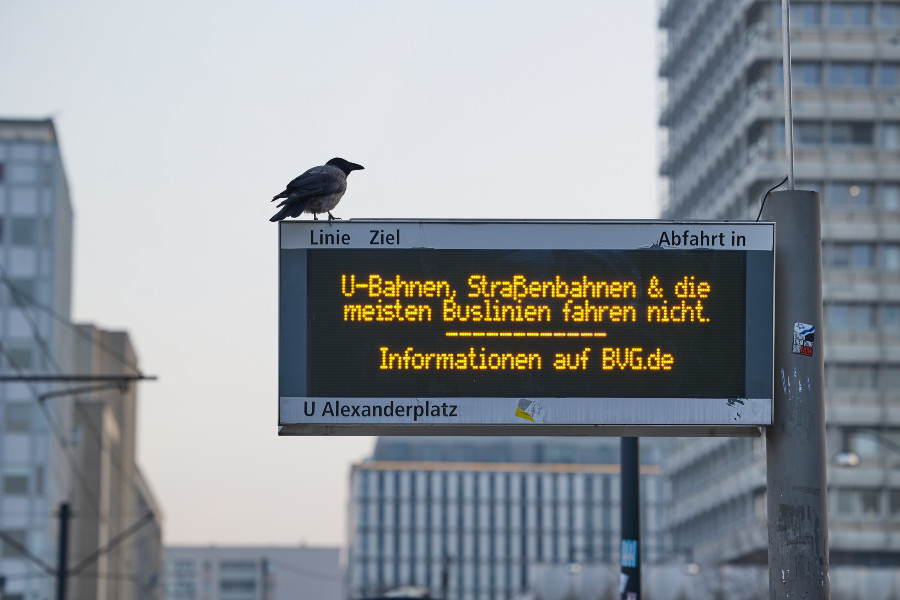
Berlin's Traffic Information Center (VIZ) also points out: "Replacement service buses that have been set up for construction work will also run during the strike."
So S-Bahn passengers riding lines that are under construction are theoretically still covered.
That said, western parts of the city has recently seen significant disruptions due to the closure of the Ringbahn bridge on the A100. Here S-Bahn trains saw repeated disruptions and major delays during last weeks strike. Drivers in this area also saw traffic jams. Basically, travellers may want to avoid the area around the Ringbahn bridge if possible.
READ ALSO: Where rail passengers can expect disruptions in Berlin and Brandenburg in 2025
Which public transportation options are available?
Berlin's above ground S-Bahn trains, which are operated by Deutsche Bahn rather than BVG, can be expected to operate as usual. But note than S-Bahn trains are often full or even overcrowded during commuter hours on strike days, and this can also lead to disruptions.
Regional trains which pass through Berlin - operated by Deutsche Bahn, Ostdeutsche Eisenbahn (ODEG) and Niederbarnimer Eisenbahn (NEB) - are also running and may be used as alternatives.
BVG's Muva (on-demand minibus service) and the commuter ferries (F10, F11, F12) will also maintain normal operations during the strike.
What other options do I have?
For shorter commutes, that are just a bit too far to walk, you can consider e-scooter, bike and ride share services.
Berlin residents will be well aware of the e-scooter rental apps (like Voi, Lime and Bolt) and bike share services (like NextBike, Lime and Bolt) that are commonly seen on the city streets.
There are also ride share services like Bolt and Uber, taxi apps like Free Now and Taxi Berlin (or simply dial 030 202020), and finally car share apps like Miles and Sixt.

There's also BVG's Jelbi app which offers access to some of the above services, and may save you the hassle of downloading and registering with multiple services.
Pro tip: make sure that you're good to go on your app of choice before heading on your way, lest you get caught trying to register and verify yourself on the side of a street somewhere whilst already running late.
Drivers should also expect that there may be more traffic that usual in and around Berlin.
To avoid running late, you'll want to give yourself a bit of extra commuting time no matter how you plan to travel during the strike.
READ ALSO: What happens if you board a train, bus, or U-Bahn in Germany without a ticket?
What happens if I'm late for work due to the strike?
In Germany the rule is that employees are responsible for starting work on time regardless of challenges involved with commuting.
Some employers could have sympathy for a one-time tardiness due to transport strikes, but don't count on it. Employees are generally expected to plan ahead accordingly.
READ ALSO: 5 tips for surviving Deutsche Bahn's new Paris to Berlin 'direct' train link
Comments