
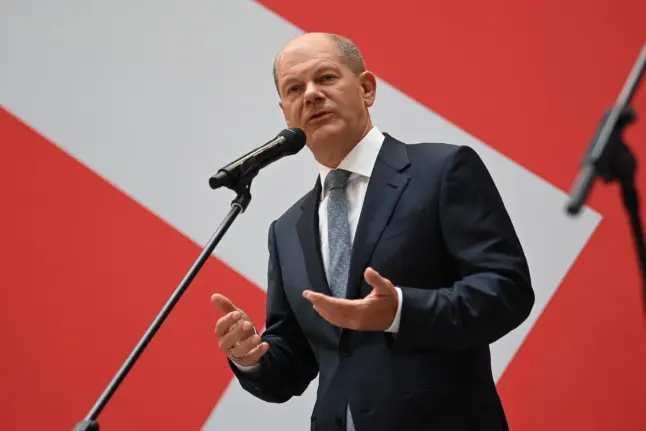
The day after the SPD delivered a result surpassing all expectations in the German elections, their vindicated chancellor candidate, Olaf Scholz, held a press conference to discuss the next steps.
The assured social democrat was laying out his plans for a future coalition and spinning his narrative of election night when he received a question from Channel 4 journalist Matt Frei on the UK's ongoing petrol turmoil.
"Are you prepared to send German truck drivers to Britain to help us with our petrol queues?" Frei put to Scholz, drawing chuckles from the crowd.
Some commentators questioned why Frei - a fluent German-speaker who was born in Germany - choose to ask the question in English at all. But it was Scholz's calm and confident response, spoken in a second language, that drew the most attention and praise on social media.
"The free movement of labour is part of the European Union," Scholz said. "And we worked very hard to convince the British not to leave the Union.
"Now they've decided different, and I hope they will manage the problems coming from that, because I think it's... an important idea for all of us, that there will be good relations between the EU and the UK. But this a problem to be solved."
READ ALSO: ‘Resurrection’: How the SPD bounced back to win German vote
Scholz also emphasised the link between Britain's ongoing shortage of long-distance lorry drivers and the unattractive working conditions for people entering the field.
"Let me just add, it might have something to do with the question of wages," he said, addressing a nodding Frei.
"If people want to (pick) a certain job, they want to know that it's something very good to do for their whole lives, and if you understand that being a trucker is something that many people really like to be, and you find not enough, then this has something to do with working conditions and this has to be thought about."
'Doesn't happen too often'
After the clip emerged, Germany's Ambassador to the UK rushed to heap praise on the would-be Chancellor, explaining that it was highly unusual for such a senior German politician to take - and answer - a question in English.
Does not happen too often that a senior German politician - and in this case the candidate of the strongest party in the German election, Olaf Scholz - accepts a question being asked in English and answers it in English. See and hear for yourself. pic.twitter.com/r3d1vtwsQs
— Miguel Berger (@GermanAmbUK) September 27, 2021
"Finally a German politicians whose English you don't have to be ashamed of," one Twitter user wrote in German, while others rushed to describe his performance as "statesmanlike" and "effortless".
Some people also drew comparisons between Scholz and Joe Biden, the Democrat who emerged victorious in the US presidential race last year.
Scholz’ version of this? pic.twitter.com/U3Kjqmx9iU
— Lorenz (@loho95) September 27, 2021
Though his potential predecessor, Angela Merkel, spoke English with most foreign leaders, she never opted to use it in public - and certainly not in any of her Berlin-based press conferences.
With one eye on the chancellorship, Olaf Scholz, on the other hand, chose to answer not one, but two questions in English.
After Frei's question on lorry drivers, a CNN journalist emerged from the woodwork, stating, “while we’re speaking English, if I may just ask one more...?"
"This is a German press conference," Scholz retorted, before giving that journalist a response in English as well.
What does all of this say about Scholz?
That the man hoping to take Merkel's job is willing to stick his neck out by fielding questions in a foreign language is a testament to his confidence.
Throughout the election campaign, the centrist social democrat has received high approval ratings and consistently come out top in polls on who Germans would like to see as their next Chancellor. (A poll released Tuesday put him at 62 percent, compared to CDU/CSU candidate Armin Laschet's 16.)
This has more than a little to do with his calm and controlled presence in debates and public appearances. The message from the SPD in this election has been all about 'kompetenz' (competence), and Scholz's gently assured mannerisms have helped convince the nation that he is a safe and experienced pair of hands.
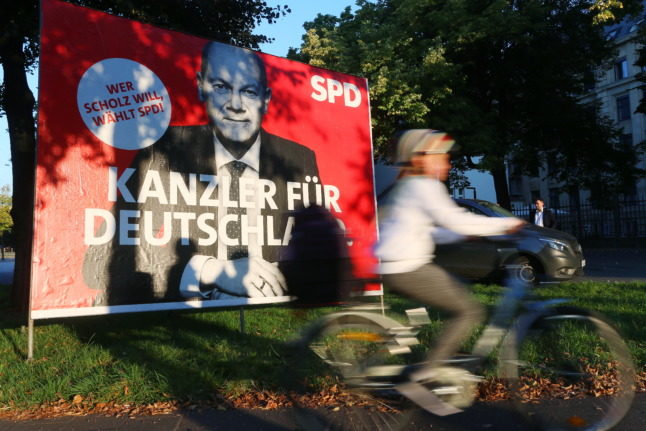
An election billboard depicts Scholz as the "Chancellor for Germany". Photo: picture alliance/dpa | David Young
His comments - described as a 'mic drop on Brexit' on Twitter by political reporter William Noah Glucroft - also say something about the attitude he may take towards free movement and Brexit if he becomes the next chancellor.
They echo the statements made in the SPD's manifesto, where the party says it must build bridges with Britain while not accepting any undercutting of EU standards on things like climate protection and workers' rights.
"Even after Brexit, the UK remains a close friend of the EU," it says.
"The joint agreements can be the foundation for a comprehensive partnership between the EU and the UK. On the basis of fair dealings with each other, we will further develop cooperation in areas that have not been regulated on so far.
"A race to the bottom, in terms of environmental standards or workers' and consumers' rights, will not be allowed."
In other words (and to paraphrase Scholz): "If you want more lorry drivers after Brexit, you should pay them as much as we do."
The next Chancellor?
Despite some bristling by German journalists at the British press invasion, analysts believe that the presence of international media at his press conference can also tell us something about how the world has viewed the election result.
“There is a little chancellor flair already in the air," the regional Rheinische Post wrote in its analysis.
"The strong presence of foreign media is at least a small indication that people in the rest of Europe believe this social democrat on the stage could succeed the great Angela Merkel after 16 years."
READ ALSO: How is the race to form a new German government shaping up?
The Post then noted that Armin Laschet “was not asked a single international question” at his own press conference. Since Laschet hails from the Rhineland, where the Post is based, the comparison hits rather close to home.
Meanwhile, the UK's Express newspaper claimed that Scholz had "shocked" the German media by fielding the question in English.
Noting that he was "quick to blame Brexit" for the lorry problems, they added that the switch of language made Scholz seem rather like a Chancellor-in-waiting.
"Doing so in English showed Mr Scholz is already 'rehearsing' for the top job, despite coalition talks still undergoing," they wrote.
As exploratory talks begin behind closed doors in Germany, the world is waiting to see what happens - and the SPD could still find themselves in opposition.
But as Scholz readies himself to try and form a government, he has already started the work of moulding himself as Chancellor - not just in Germany, but on the world stage.
Comments (2)