
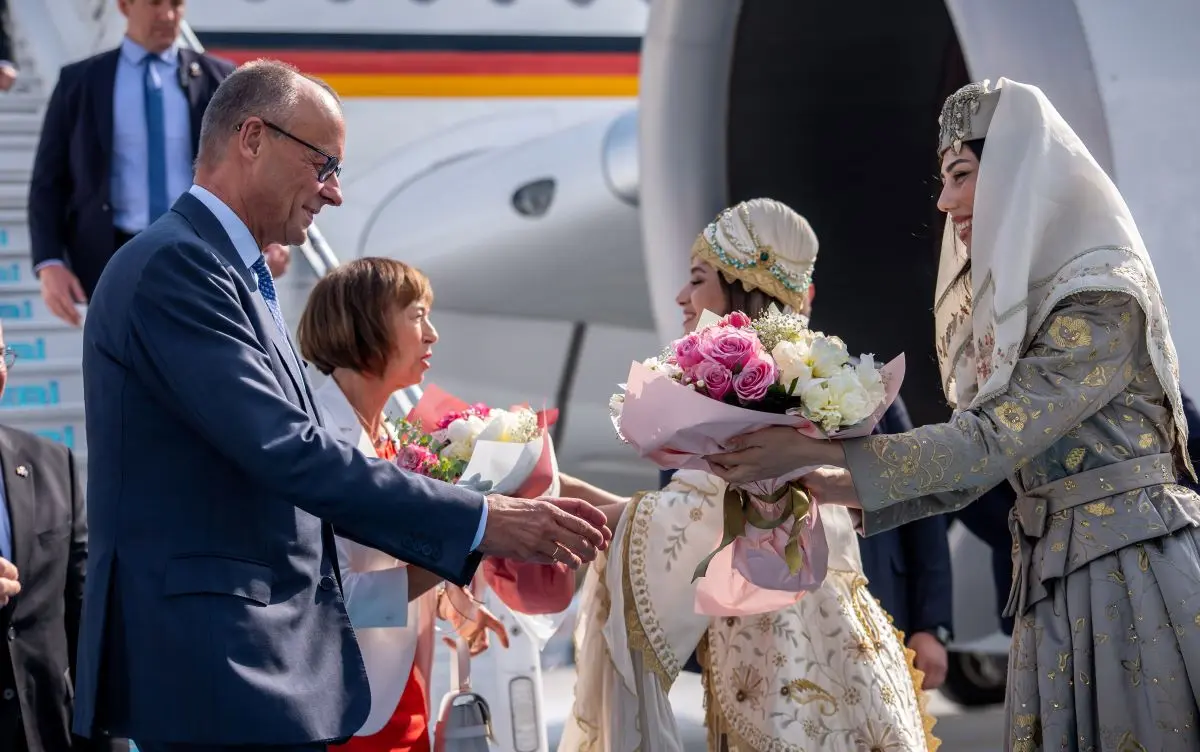
Wednesday's top story: Germany showcases record defence spending at NATO Summit
Germany heads into the NATO summit in Ankara seeking to reassure US President Donald Trump that Europe is taking greater responsibility for its own defence, backed by record levels of military spending and a commitment to stronger European security.
Ahead of the meeting, NATO released new figures showing that defence spending now accounts for 2.69 per cent of German GDP.
Germany will spend €124.7 billion on defence in 2026, an increase of 25.5 percent compared with the previous year and the highest level in recent history, second only to the United States within the alliance.
Chancellor Friedrich Merz, along with other European leaders, is expected to use the summit to underline the continent’s growing contribution to NATO at a time when Trump continues to question whether European allies are doing enough.
Despite approving a target for NATO members to spend five percent of GDP on defence and security by 2035, Trump recently criticised Germany’s contributions as insufficient.
Germany is also backing plans for increased European responsibility within NATO and is supporting a new package of military aid for Ukraine worth billions of euros. Merz said the commitment should demonstrate to the Kremlin that Russia cannot achieve its war aims.
READ ALSO: Big defence spending and new taxes - German cabinet approves budget
German startup boom reaches record high as AI drives new businesses
Germany recorded a record number of startup launches in the first half of 2026, with more than 3,000 new companies founded as artificial intelligence helps drive a new wave of entrepreneurship.
According to a study by the Startup Association, 3,053 startups were established between January and June, the highest six-month figure ever recorded in Germany.
The total represents a 52 percent increase compared with the second half of 2025 and exceeds the number founded during the whole of 2024.
The growth has been largely fuelled by artificial intelligence, which is making it easier and cheaper for entrepreneurs to launch businesses. More than a third of all new startups – 1,038 companies – have a clear connection to AI, while software remains the strongest sector overall with 844 new firms.
Berlin retained its position as Germany’s leading startup hub with 429 new companies, although growth there was relatively modest.
Hamburg emerged as the surprise performer, with 212 startups, overtaking Munich for the first time in years.
Strong growth was also recorded across Bavaria, North Rhine-Westphalia and Baden-Württemberg.
Despite the surge, industry leaders caution that Germany still trails far behind the United States, which is home to more than 900 billion-dollar startups. Germany currently has 36 such “unicorn” companies, including six added this year.
READ ALSO: 'Germany Fund' launched to boost startups
Traffic deaths rise in Germany despite long-term safety gains
An average of eight people were killed and more than 1,000 injured every day on Germany’s roads in 2025, according to new figures from the Federal Statistics Office.
A total of 2,832 people died in road accidents last year, 62 more than in 2024. Around 371,000 people were injured, an increase of 1.7 percent. Of those, approximately 49,200 suffered serious injuries, while 322,000 were classified as minor injuries.
Despite the rise in fatalities, the number of seriously injured people fell to its lowest level since separate records for serious and minor injuries began in 1991, reflecting longer-term improvements in road safety.

READ ALSO: Key changes for drivers in Germany starting July 1st
Excessive or inappropriate speed remained the leading cause of fatal crashes. Alcohol also continued to be a significant factor, with 34,800 accidents involving at least one person under the influence of alcohol. On average, an alcohol-related accident occurred every 15 minutes.
Children were particularly affected. A child was injured in a traffic accident every 18 minutes, while 74 children under the age of 15 died on Germany’s roads in 2025, up from 53 the previous year. The number of injured children rose by 7.3 percent to around 29,200.
Overall, police recorded approximately 2.52 million traffic accidents in 2025, slightly more than the previous year. However, the long-term trend remains positive: in 1995, around 9,500 people were killed and more than 500,000 injured in road accidents across Germany.
Germany sees surge in bakery bankruptcies
Germany’s bakery sector is coming under increasing strain, with the number of insolvencies jumping sharply as consumers increasingly buy bread and pastries from supermarkets and discount chains.
According to credit agency Creditreform, 63 bakery businesses filed for bankruptcy in the first half of 2026, a rise of 40 per cent compared with the same period last year. The figures include bakeries and confectioners that produce and sell their own baked goods, with several larger chains among those affected.
Industry experts say the trend reflects a broader shift in consumer behaviour. More shoppers are now picking up bread rolls, pastries and snacks during their weekly supermarket shop rather than making a separate trip to a traditional bakery.
That change is proving particularly challenging for smaller, independent bakeries, which are facing rising operating costs, intense price competition and customers looking to save money. With profit margins already tight, many businesses have struggled to pass higher costs on to consumers.
The longer-term picture is equally stark. Germany had 8,659 bakery businesses at the end of last year, down from more than 12,000 a decade earlier.
READ ALSO: Will Germany allow shops to open on Sundays?
Government plans record sports budget for 2027
Germany’s government is set to allocate a record €361.7 million to sport in 2027, providing a significant boost to elite athletes, national federations and Olympic preparations despite wider pressure on public finances.
The draft budget, approved by the federal cabinet, has been welcomed by both the German Olympic Sports Confederation (DOSB) and the German Sports Aid Foundation (Sporthilfe).
Sporthilfe described the funding increase as a “milestone” that would enable the most substantial improvement in athlete support for years.
A key element of the package is an additional €4.5 million for direct athlete assistance, allowing higher monthly payments for top and emerging competitors. The funding is expected to particularly benefit athletes who are not supported through the armed forces, police or customs services.
The government has also doubled funding for Germany’s Olympic bid to €6 million, a move the DOSB said demonstrated confidence in the country’s ambition to host future Games.
The proposed 2027 allocation follows steady increases in recent years, rising from €333 million in 2025 and approximately €359 million in 2026.
READ ALSO: How Berlin's Olympics bid would reshape the city
With reporting by AFP and DPA.
Comments