
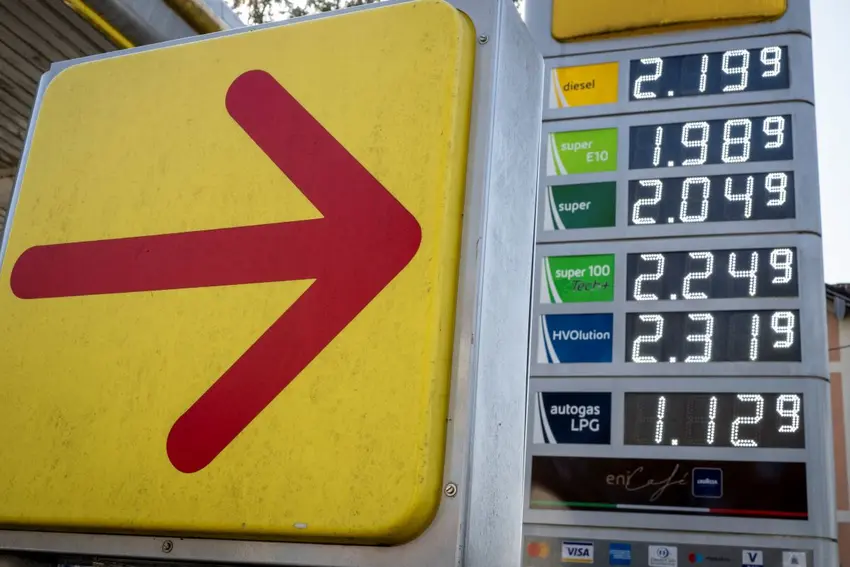
Drivers across Europe are feeling the impact of renewed conflict in the Middle East. The attack on Iran by the US and Israel has disrupted a key shipping route in the Strait of Hormuz, which has dramatically driven up the price of crude oil (above 90 US dollars a barrel at time of writing).
Around the world fuel prices are rising as a result, but recent analysis shows that German fuel prices have risen more sharply than the EU average.
So how much more are those in Germany paying at the pump, and how can drivers save a bit of money when they need to refuel?
How much higher are fuel prices in Germany?
Ahead of the fuel price spike, Germany was already one of the most expensive fuel markets in the European Union.
Tomaso Dusa, Head of the Monopolies Commission, wrote in an article for Die Zeit that petrol prices in Germany tend to be around 20 percent above the EU average as a rule.
He added that around 64 percent of the price for petrol and 56 percent of the diesel price in Germany consist of taxes and duties, including energy tax, VAT and carbon tax. But while high taxes might explain why fuel is generally expensive in Germany, they don’t explain why prices are rising faster here than elsewhere.
READ ALSO: Why it pays to exit the Autobahn to refuel in Germany
In the week from February 23rd to March 2nd, petrol prices at German filling stations reportedly rose by 3.5 percent and diesel prices by 4.6 percent, roughly twice the EU average increase of 1.5 and 1.8 percent respectively.
Among all EU member states, only Finland recorded stronger price increases during that period.
Looking at absolute prices, a litre of diesel in Germany recently cost €2.237 while Super E10 was priced at €2.095, according to the ADAC (Germany’s largest motoring organisation).
In comparison, Austria reported average prices of €1.959 per litre for diesel and €1.729 for petrol.
Several experts have argued that the reason fuel prices are rising faster in Germany is because of how the market functions.
For example, economists cited by Der Spiegel have calculated that pump prices in Germany have risen significantly more than crude oil prices since the outbreak of the Iran war, which they interpret as oil companies expanding their margins.
Energy analyst Steffen Bukold reached a similar conclusion, arguing in Frankfurter Rundschau that current price increases reflect pricing decisions made by oil companies that control both oil refineries and petrol stations.
A spokesperson for the Fuels and Energy Trade Association rejected the accusation, saying that the higher prices are justified by higher product prices for petrol and diesel, a weaker euro and increased transport costs.
Is the government acting to stabilise fuel prices?
On Wednesday, Economics Minister Katherina Reiche announced that the government wants to allow price increases at petrol stations only once per day while permitting reductions at any time – following a system which is already in place in Austria.
In addition, Reiche also announced that Germany would release part of its national oil reserves to help stabilise prices.
READ ALSO: EU countries urged to lower energy taxes to reduce consumer bills
Federal Finance Minister Lars Klingbeil (SPD) has talked about consequences for oil companies if they try to take advantage of the conflict in the Middle East.
“There must be no rip-offs now, and politicians take action and proceed clearly and consistently,” he said on the program ZDF spezial.
Germany’s Federal Cartel Office is monitoring price developments and has opened proceedings into possible distortions of competition. But its president, Andreas Mundt, has warned that such investigations take time and cannot deliver immediate relief for drivers.
What can drivers do to save money?
While policy debates continue, drivers are not completely powerless.
The ADAC advises motorists to plan refuelling carefully, especially when travelling abroad, as fuel is often significantly cheaper in countries such as Luxembourg, Austria, Poland and Czechia.
Within Germany, avoiding motorway service stations and using price comparison apps such as the ADAC Drive app can help identify cheaper filling stations in real time.
READ ALSO:
Comments