
Tuesday's top story: Carnival Committee President defends Düsseldorf float builder
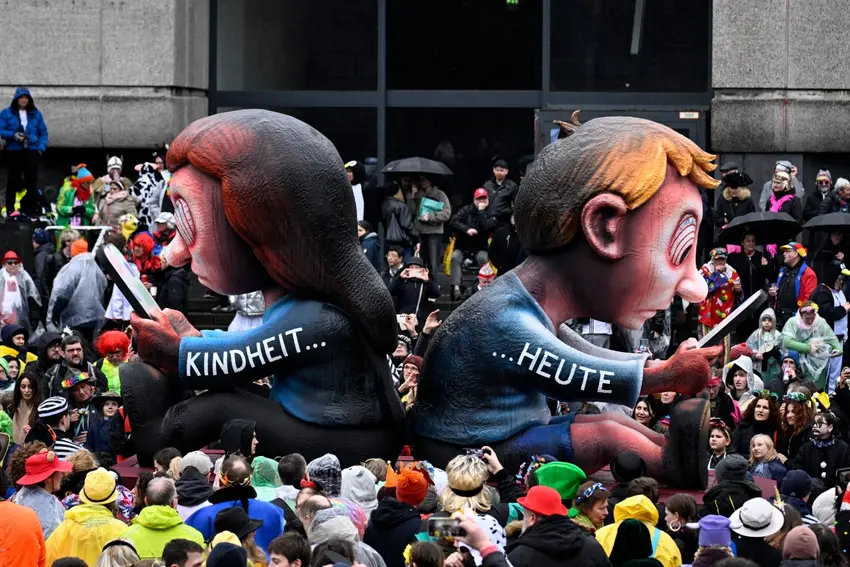
From Donald Trump to Vladimir Putin, no-one is safe when Germans celebrate carnival with floats that satirise politicians. But the Russian president is not laughing.
Sculptor Jacques Tilly, head float designer for Düsseldorf's parade, is on trial in absentia in Moscow, accused of spreading false information about the Russian military.
"Humour can hurt and definitely affect those targeted," he told AFP in December, promising that the political floats for today's parade would be as "foolish and satirical" as ever.
The outgoing president of the Cologne Carnival Festival Committee, Christoph Kuckelkorn, voiced strong support for Tilly.
Speaking on Deutschlandfunk radio, Kuckelkorn said that criticism must be allowed and tolerated. The comments came as the street carnival in the Rhineland reached its climax with Rosenmontag parades.
In pictures: Germany's Carnival floats take swipes at Putin, Trump and Epstein
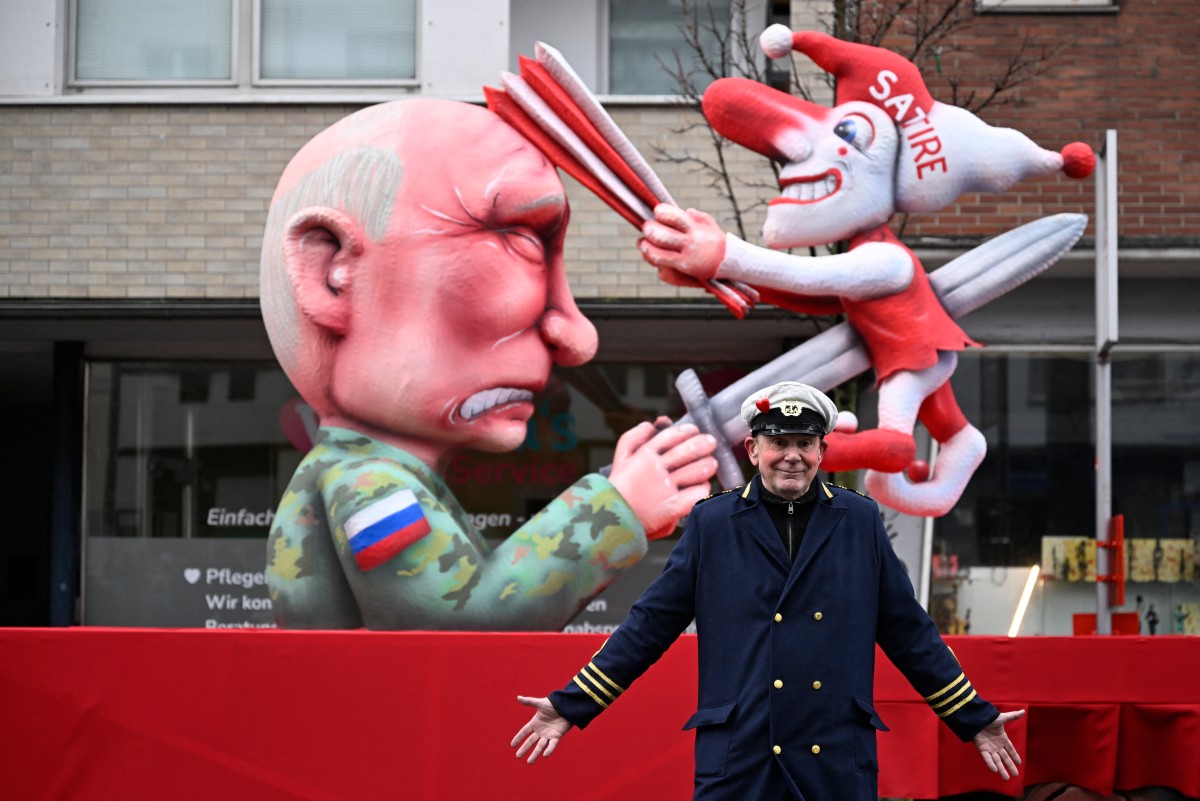
This year, Vladimir Putin appears on three of Tilly’s floats. One addresses the legal action directly, showing a grim‑faced Putin attacking a small carnival jester, who strikes back with cardboard.
Meanwhile, the city of Cologne will not feature a Putin float this year. Instead, other political figures and themes are being satirised, including Iran’s supreme leader Ayatollah Ali Khamenei and the Alternative for Germany (AfD) party.
Deutsche Bahn railways between Braunschweig and Magdeburg are closed
Deutschlandfunk radio shared a police report that several loaded cars had burned on a freight train in Magdeburg.
According to Deutsche Bahn this had led to disruptions for long-distance passengers passing through the region. There are diversions and partial cancellations.
The railway operator has said that the Dresden-Stuttgart and Dresden-Norddeich connections specifically are affected.
Social Democrats join conservative partners in calling for social media ban for children
A group of German centre-left Social Democrat leaders (SPD) have joined their conservative coalition partners in calling for a ban on social media access for children under 14.
Following a similar ban, recently enacted in Australia, there have been growing discussions in Germany and other European countries about the negative effects of social media on children, and whether state-enforced restrictions are in order.
"We can no longer avoid clear rules and restrictions," Vice Chancellor Lars Klingbeil told Der Spiegel. "Protecting young people from the flood of hatred and violence on social media is a top priority."
A discussion paper, signed by a group of SPD lawmakers, calls for platforms to block access for children under 14 and to create special "youth versions" for those aged 14 to 16, without algorithm-driven feeds, personalised content, or functions like endless scrolling or autoplay.
Australia has curbed access to social media platforms including Facebook or Instagram, Snapchat, TikTok and YouTube for minors.
READ ALSO: Where are smartphones banned in primary schools in Germany?

Number of right-wing violent incidents increased last year
German police counted more right-wing politically motivated violent crimes in Germany in 2025 that the year before, according to a government response to an inquiry by the Left party.
According to government figures, 1,521 cases of right-wing violence had been recorded last year as opposed to 1,488 in the previous year and 1,270 the year before that.
The figures are preliminary and could be updated as more information comes in, as some cases are still under investigation.
Violent offenses include attempted murder and bodily harm, as well as serious breaches of peace, dangerous interference with road traffic, unlawful detention and resistance to law enforcement.
Defamation of the state and its symbols, and hate speech are classed as nonviolent crimes and would not be included here.
Berlin state library to close for 11 years
One of Berlin’s most prominent cultural landmarks, the State Library near Potsdamer Platz, is set to close for 11 years starting in 2030 to undergo a comprehensive renovation.
The project will cost an estimated €1.1 billion, according to Marion Ackermann, president of the Prussian Cultural Heritage Foundation (SPK), which oversees the library. The aim, she said, is to modernise the listed building and secure its future.
The renovation represents a major logistical challenge. The library houses more than 5.4 million books and other media, all of which will need to be relocated to temporary storage.
READ ALSO: Everything you can borrow from a library in Germany
The building, constructed between 1967 and 1978 as part of Berlin’s Kulturforum and designed by architect Hans Scharoun, covers more than 110,000 square metres across twelve floors and also accommodates the Ibero‑American Institute.
Preparatory work is already under way and is expected to be completed by 2030, when the building will close for the same length of time as its original construction period. A replacement building is planned nearby for around 650 employees, while book lending will continue via external depots.
The State Library’s second site on Unter den Linden will remain open throughout the renovation.
German and British military chiefs warn of growing Russian threat
Senior military leaders from Germany and the United Kingdom have warned that Russia is rapidly rearming and increasingly orienting its military posture toward the West.
In a joint appeal, Carsten Breuer, Inspector General of the German Armed Forces, and Richard Knighton, Chief of the General Staff of the British Armed Forces, called for a strengthening of military preparedness and a significant expansion of the European arms industry.
Writing in guest articles published by Die Welt and The Guardian, the two commanders said Russia’s military build‑up was increasing the risk of conflict with NATO countries. Combined with Moscow’s demonstrated willingness to wage war in Europe, they argued, the developments demand urgent and coordinated attention from European states.
Breuer and Knighton stressed that the war in Ukraine has highlighted the decisive role of industrial capacity in sustaining large‑scale military operations. Expanding arms production, they said, should not be seen as warmongering but as a responsible measure to protect populations and preserve peace.
The appeal comes amid broader calls for closer alignment with Western allies and renewed debate over Europe’s security posture in the face of Russia’s continued aggression.
With reporting by AFP, DPA and Tom Pugh.
Comments