
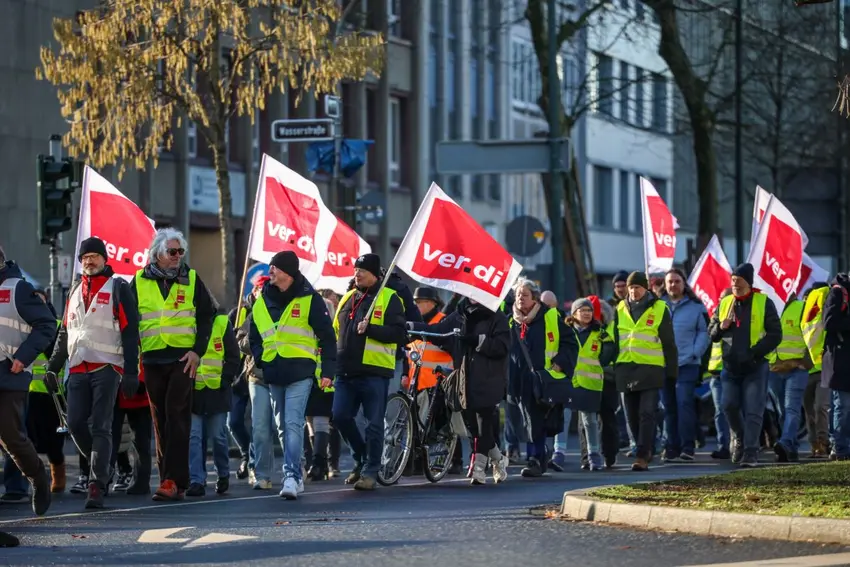
Germany faces another wave of public‑sector walkouts this week, with unions calling for widespread strikes across healthcare, education, public administration and other state services.
In particular, people living in North Rhine‑Westphalia (NRW), Baden‑Württemberg and central Germany may notice delays, cancellations or reduced access to essential services.
Where strikes are set to take place on Monday (February 9th)
Monday’s strikes will be concentrated mainly in two regions.
In North Rhine‑Westphalia (NRW), a two‑day strike will hit major university hospitals in Aachen, Essen and Cologne. These hospitals have already warned that patient care will be restricted, although emergency treatment will still be available.
Alongside the hospital walkouts, schools, universities, public prosecutors’ offices and the state road agency (Straßen.NRW) are also expected to be affected.
In Baden‑Württemberg, the focus will be on Stuttgart and Heilbronn, where almost all state institutions are expected to join the action. This covers universities and colleges, the state parliament and ministries, student services and a wide range of cultural institutions, including Wilhelma, the State Gallery and the State Theatre.
The Weinsberg Centre for Psychiatry and its branch in Schwäbisch Hall are also likely to be affected. Large demonstrations are planned in both Stuttgart and Heilbronn on Monday morning.
READ ALSO: The in demand jobs that make it easier to move to Germany
In central Germany, strikes are expected to begin at Leipzig University Hospital, with more widespread action expected to follow on Tuesday.
Where strikes are set to take place on Tuesday (February 10th)
On Tuesday, the strikes are expected to spread further across the country. In North Rhine‑Westphalia, walkouts will continue at the university hospitals in Aachen, Essen and Cologne. Schools, universities and state authorities will also be affected, and Düsseldorf is set to host a major demonstration.
In Baden‑Württemberg, additional cities are likely to join the industrial action. Strikes are expected in Tübingen, Karlsruhe, Mannheim and Heidelberg, causing widespread disruption to public services and university operations.
Across Saxony, Saxony‑Anhalt and Thuringia, a broad range of state‑run services will be disrupted, including state authorities, schools, universities and research institutions. University hospitals such as those in Halle, Jena and Leipzig are also likely to be affected.
In Thuringia, staff from educational institutions are expected to take part in a large rally in Jena, bringing together employees from schools, after‑school care centres, universities and student union childcare facilities.
How residents could be affected
Hospital services in affected areas are likely to face delays due to reduced staffing, with non‑urgent treatments postponed.
Some schools may close or cancel classes, providing only emergency childcare where needed. Universities may scale back services or cancel lectures, and visiting public offices could mean noticeably longer waiting times or even temporary closures.
READ ALSO: What are the rules in Germany for being late to work due to strikes?
Traffic delays are also possible in larger cities because of marches and demonstrations. Some daycare centres – particularly those run by Awo – may close entirely on Monday and/or Tuesday.
People who have appointments at hospitals, schools or government offices on Monday or Tuesday are advised to check in advance if they will still be taking place.
Why the strikes are happening
These warning strikes are part of a major public‑sector wage dispute across Germany’s federal states. Unions – including Verdi, GEW and others – are calling for a 7 percent salary increase (or at least €300 per month), along with an additional €200 per month for junior staff.
The timing is deliberate, as unions aim to increase pressure in the run‑up to the third and final round of negotiations, which is scheduled to begin on February 11th in Potsdam.
Comments