
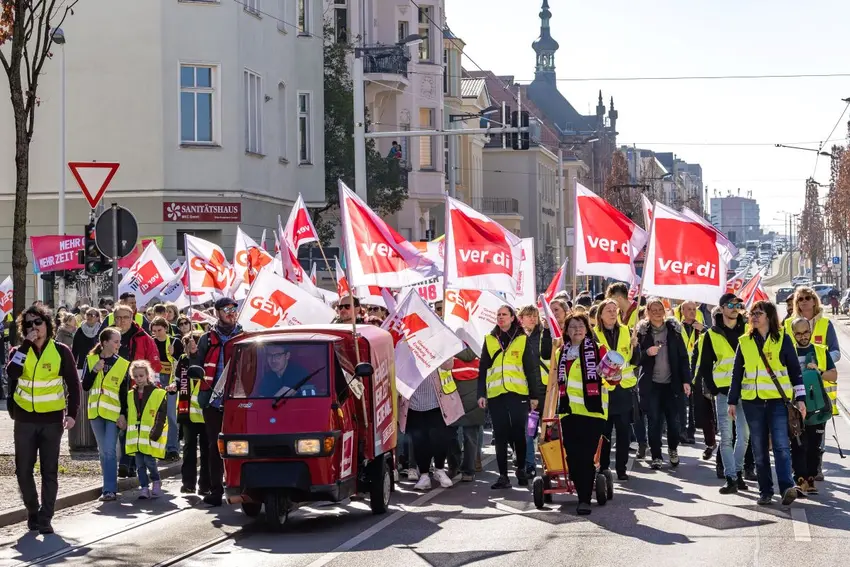
Hospitals, universities, schools and public services were disrupted in parts of Germany on Tuesday morning as warning strikes escalated in a major wage dispute.
The strikes come as part of the latest collective bargaining dispute between trade unions and the federal states, with the unions – including ver.di, dbb and GEW – demanding more pay for workers. In many cases the unions are demanding a seven percent salary increase or at least an additional €300 per month for lower wage groups.
The federal states have so far rejected these demands as unaffordable, citing a two percent inflation rate.
The warning strikes are expected to last only a few hours or a single day at many locations, although at some sites such as Cologne University Hospital, actions are scheduled to continue over two days (on January 13th and 14th).
Hospital patients affected
Tuesday's wave of warning strikes is being felt at university hospitals, with operations being cancelled at several sites in North Rhine-Westphalia, including Cologne, Düsseldorf, Bonn and Essen.
For patients, the most immediate effects are likely to be delays in elective medical treatments, university services and with related administrative processes.
In Cologne, two-thirds of planned operations are expected to be cancelled on Tuesday and Wednesday, although emergency services remain available.
READ ALSO: Jobs in Germany - Should foreign workers join a union?
Bonn University Hospital anticipates half of its operations will be affected, while Düsseldorf is experiencing a one-day strike involving nurses, laboratory staff and other employees. Doctors are not participating, as their pay is regulated separately.
Emergency medical care remains available. Residents are advised to check with local providers for updates and to expect possible demonstrations in affected areas.
Where else are strikes taking place?
Unionised employees of universities, clinics and administration offices in Leipzig were on strike on Tuesday, and a related rally began at 9 am.
The ver.di union has also called for strike action in the southwest, according to reports by the Stuttgartner Zeitung, where the Esslingen area was affected on Tuesday. Work stoppages were also planned for Tübingen, Karlsruhe and Mannheim on Wednesday.
In Lower Saxony, unions have called on state employees to participate in a full-day warning strike on Wednesday, affecting Leibniz University Hannover, the state's construction management, central IT services and road maintenance offices.
In Mecklenburg-Vorpommern, strike action by teachers is expected on Wednesday which could lead to class cancellations, according to the Ministry of Education. Approximately 65 percent of the region’s teachers are eligible to strike.
READ ALSO: ‘Schulpflicht’ - What parents need to know about kids missing school in Germany
Berlin faces the prospect of a two-day public sector warning strike on Wednesday and Thursday, according to reporting by taz, which could lead to disruptions in municipal nurseries, schools, universities and public offices. While complete school closures are unlikely, the GEW union has indicated that lessons or after-school care may be cancelled on Wednesday.
Also in Berlin, parts of the nursing staff and employees of four DRK clinics went on strike on Tuesday.
In Middle Franconia a strike planned for Wednesday is expected to affect the University Hospital in Erlangen as well as Friedrich-Alexander-Universität (FAU) and certain municipal offices in Nuremberg and Erlangen.
What can be expected?
The current dispute involves around 925,000 public sector employees, and further action may follow if negotiations remain unresolved.
Warning strikes in Germany typically last anywhere from a few hours to one or two days. They serve as a pressure tactic used by unions to encourage employers to make concessions, without escalating to a full-blown conflict which could involve more serious 'unlimited' strikes.
Warning strikes in various sectors are commonly seen in Germany near to the start of the year when various companies negotiate renewed collective bargaining agreements with their workers. The current strikes are taking place ahead of the next round of collective bargaining negotiations for many public service workers, which is scheduled for January 15th and 16th in Potsdam.
Comments