
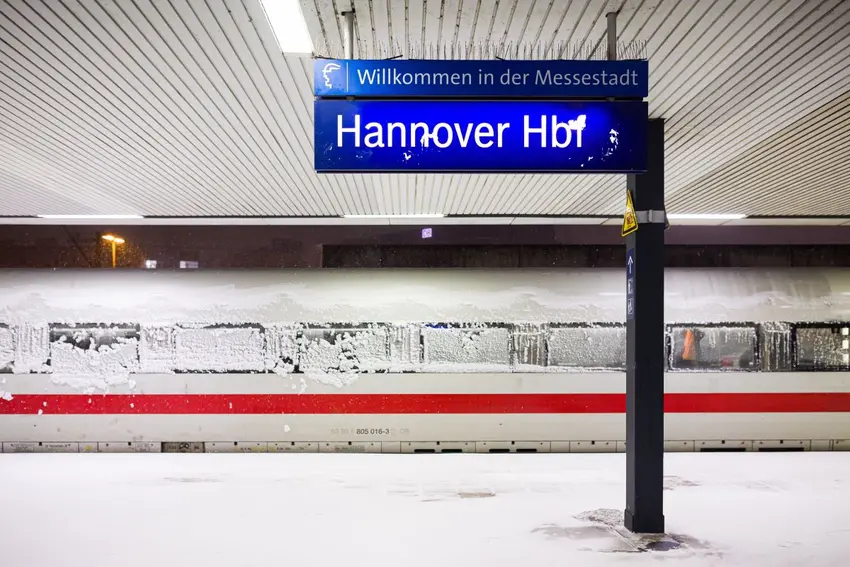
Deutsche Bahn (DB) has warned that Storm Elli is likely to cause delays and train cancellations in long-distance traffic, and disruptions in some regional services into the weekend.
The national railway operator is asking passengers to postpone their journeys if possible and announced that all passengers who had purchased a ticket for a train within the period from January 7th until January 10th can use their ticket at a later date.
In this case, your previous ticket would be valid for travel to the original destination, even if you travelled by a different route. Seat reservations can also be freely cancelled, and in some cases tickets could be refunded entirely.
READ ALSO: 'Postpone your trip' - How winter Storm Elli is affecting lives in Germany
But what are the rules for claiming compensation for delayed or cancelled trains in Germany?
When can I get reimbursed for a train ticket?
If a train is significantly delayed or cancelled altogether, affected passengers are normally entitled to compensation - even in the event of a strike - according to the EU Passenger Regulation.
Those who arrive at their destination one hour late are entitled to a reimbursement of 25 percent of the fare, whereas, for two hours, the responsible rail company must refund 50 percent of the fare.
Passengers can choose between a voucher or payment of the compensation amount.
When there’s an expected delay of 20 minutes at the destination station, passengers are entitled to take another train. Higher-quality trains can also be used, provided they don't have to be reserved in advance.
In practice, this means that the restriction to travel on a specific train, for example with a Saver (Sparpreis) ticket, is automatically lifted and your ticket will be valid for an alternative connection on the booked route.
READ ALSO: LISTED - The big changes for travel in Germany in 2026
But if you’re travelling on a local train ticket (RE, RB, IRE and S-Bahn) and would like to use a higher-quality train to continue your journey, you first have to pay for the additional ticket required.
You can then apply to have the costs reimbursed via Deutsche Bahn’s Passenger Rights Service Centre. But note that this rule does not apply if you were originally travelling on the Deutschlandticket or similar “significantly reduced” options such as the Länder-Ticket or Quer-durchs-Land-Ticket.
Delays always refer to the arrival time at the destination. For example, if you miss the connecting train because your first train is ten minutes late, and then arrive at your destination an hour later, you would be entitled to compensation.
When can I cancel my trip or return my ticket?
If it's already clear before departure that the train will arrive at its destination at least one hour later than planned, passengers have a right to cancel the trip and request a full refund. This also applies to cancelled trains or missed connections.
Those who are already en route and break off the trip can have the unused part of the journey refunded. If you return to the departure station, you will even be refunded the full price.
How does ticket reimbursement work?
Deutsche Bahn recommends asking rail staff to confirm the delays. The consumer advice centre also advises passengers to take photos of display boards showing delayed or cancelled trains, or take screenshots from their app or website.
READ ALSO: What's the best option when buying public transport tickets in Berlin?
Passengers can then use these documents, along with the ticket and the completed passenger rights form, to claim compensation for the journey. The form should be available directly on the delayed train, at the railroad travel centre or online for download. The documents have to be sent to the railroad or handed in at the travel centre.
It's now also possible to handle refunds digitally: if the ticket was purchased online, compensation can be claimed via the customer's own account in the Bahn app or on DB's website.
All refunds have to be claimed within one year of the end of the ticket's validity period - a condition which is always noted on the ticket.
When does Deutsche Bahn cover the cost of hotels and meals?
If you become stranded at a train station due to delays in the evening and can't continue your journey until the next day, you are entitled to substitute transportation or, in the worst case, accommodation and a meal there.
Payment for overnight stays caused by “force majeure” (for example, extreme weather or sabotage) can be limited to three nights.
Getting to your destination by bus or taxi - who pays?
Deutsche Bahn has previously organised collective trips by cab or bus and issued vouchers for them. But if this is not possible, passengers can also organise a taxi themselves - the reimbursement costs for which are capped at €120.
The fare can only be refunded, however, if the train's scheduled arrival is between midnight and 5 am and if the expected delay at the destination station is at least one hour. Passengers must also check whether the destination station could also be reached before midnight by another means of transport.
READ ALSO: How rail journeys across Europe could be made faster in the coming years
Late to work: what are my rights?
If you depend on the train to get to work, simply staying at home is (usually) not a defensible option.
Anyone who wants to work from home or take leave at short notice because of expected train cancelations - such as during ongoing strikes or other service disruptions - must discuss this with their employer as early as possible.
If you don't work, you're not entitled to a wage – and that also applies if you arrive late at work because of a strike or other train delays. The so-called travel risk is always borne by the employee in Germany – regardless of cause.
Unfortunately, employees do not have a legal right to make up for missed work time, unless an employment contract or collective agreement states otherwise.
With reporting by Tom Pugh.
Comments (2)