
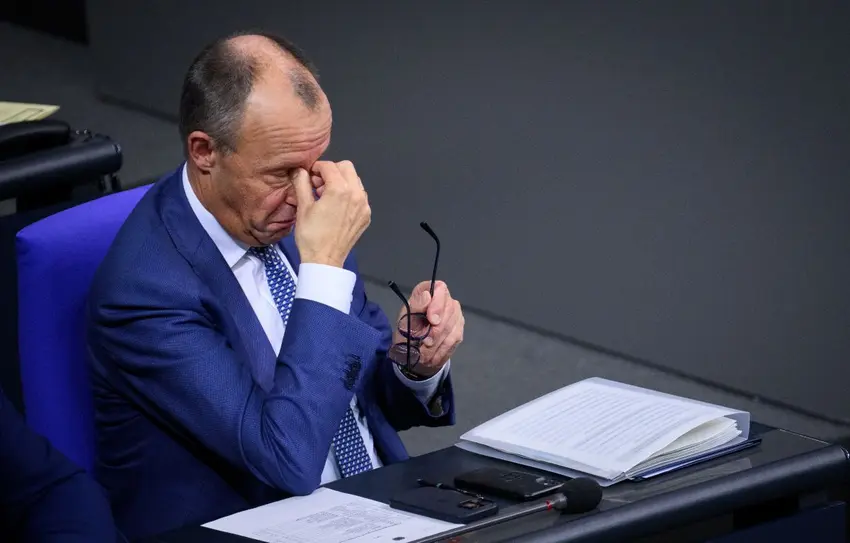
The black-red coalition, comprised of the centre-right Christian Union parties (CDU/CSU) and the centre-left Social Democrats (SPD), took the reigns of Germany's federal government at what should have been an ideal time. Sworn in on May 6th, 2025, there was then nine months to go without a single state election -- ideal conditions to focus on important projects without the pressure of coalition politics getting in the way.
But months later, following a nearly fumbled election to chancellor for CDU-leader Friedrich Merz, the failed confirmation of a federal judge, and walked-back promises about lower electricity prices for households and stabilising health insurance contributions, to name just a few examples, it's clear that black-red leaders are up against bigger challenges than they seem to have anticipated.
So what can be expected in German domestic politics next year? Here's a look forward to the state elections we'll be watching closely in the year to come, as well as some major reforms the federal government can be expected to pursue.
Political battles in the states
Five state elections are scheduled for 2026, and the SPD in particular looks likely to lose control of prime minister positions in some states. There is also a significant chance that the far-right Alternative for Germany (AfD) could win some state elections, putting the party in a position to try and lead a state government for the first time.
The south-western states of Baden-Württemberg and Rhineland-Palatinate will be the first to go to the polls in March 2026.
In Baden-Württemberg the current Prime Minister, Winfried Kretschmann (Greens), is stepping down, leaving his successor, Cem Özdemir, to fight for the leading position in the state, but barring a major shift it looks like the CDU candidate there, Manuel Hagel, is more likely to take over.
Meanwhile in Rhineland-Palatinate, which will go to the polls just a couple of weeks later, the position of prime minister looks likely to be handed over from the SPD to the CDU. If so, that would put further pressure on SPD leadership; the party has been struggling since the last federal election when it recorded its worst result since 1887.
Bigger drama, however, can be expected in the run-up and aftermath to elections in the east and north-eastern states of Saxony-Anhalt and Mecklenburg-Western Pomerania in September. The anti-immigration AfD sees some of its strongest support in parts of these states -- up to 40 percent in recent polls.
READ ALSO: Alternative for Germany members travel to the US on taxpayer money
In Saxony-Anhalt political commentators have begun to suggest that the party could win the prime minister's position for the first time.

The CDU in Saxony-Anhalt continues to reject the idea of forming a coalition with the AfD, but at the time of writing, the latest poll results suggest that a majority coalition without the AfD would only be possible in a four-party alliance with the SPD, BSW and the Left. And the CDU has so far also rejected the idea of forming a coalition with the Left.
The situation is similar in Mecklenburg-Western Pomerania, where the SPD currently leads the state government but is polling far behind the AfD.
On September 20th, Berlin will also have its state elections. In the capital the CDU, SPD and Greens still have a clear joint majority whereas the AfD polls around 15 percent.
Social reforms: How radical will they be?
While state-wide election campaigns play out in the background, the federal government will also be pushing forward a number of social reforms. Already on the docket is a significant reform to the long-term unemployment benefit Bürgergeld which is set to take effect in the first part of the year.
Regarding health insurance and pensions, commissions will meet to discuss possible reforms. There is some reason to doubt that serious reforms will be agreed here -- largely because the committees include coalition politicians. There have been some calls to extend the retirement age, for example, but the SPD has always rejected this proposal.
OPINION: Why Germany’s pensions problems will soon be your problem
Another point of contention that could push to conflicts in the coalition is around whether civil servants should be included in the statutory pension.
Half of voters expect another government collapse
According to a YouGov survey on behalf of the German Press Agency, only nine percent of Germans believe that the Union and SPD will argue less in the coming year. Nearly half (49 percent) think things will continue as they have so far, and 21 percent expect an increasing dispute.
Confidence that the current government will remain stable for the next three years until the next election cycle is also shaky at best. Almost half of Germans (49 percent) believe the black-red coalition will collapse before then with 17 percent expecting a breakdown in the coming year, and another 32 percent expecting it a year after that.
Roughly one in three people expect the alliance to hold out until 2029.
With reporting by dpa.
Comments