
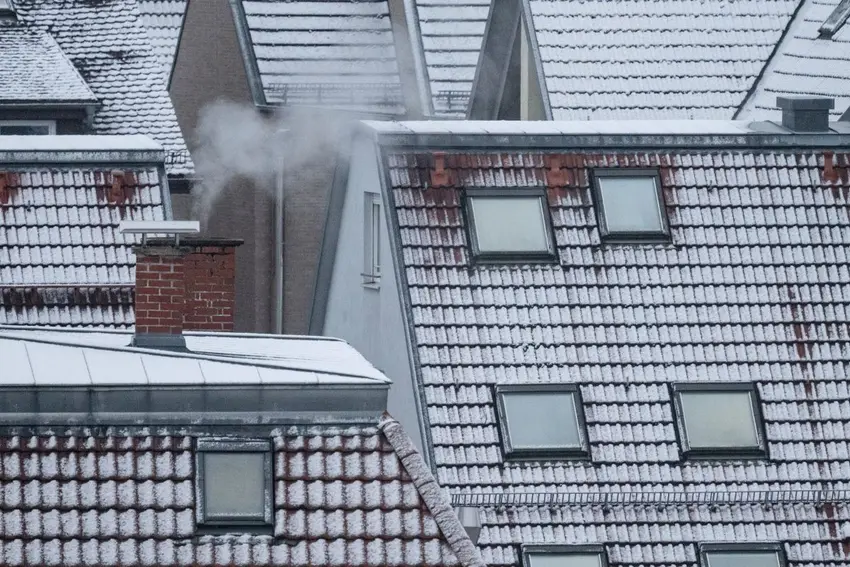
Tenants’ associations across Germany have sounded the alarm as more and more residents seek advice for dealing with rising heating costs.
The surge in demand for advice comes in the wake of the expiry of government energy price brakes and the end of temporary VAT reductions on gas and district heating.
“Many tenants are surprised that they have to pay significantly more,” said the head of the legal department at the Hamburg tenants’ association.
The news comes at the same time as the Federal Environment Minister confirmed that subsidies for replacing heating systems with more climate-friendly alternatives – namely heat pumps – will remain in place.
Why are heating costs rising so quickly?
Heating costs in Germany have risen sharply over the past year, leaving many tenants and homeowners facing unexpectedly high bills.
A couple drivers behind the increasing costs have been the expiration of the government’s energy price brakes on gas, district heating, and electricity at the start of 2024, as well as the end of a temporary VAT reduction on gas and district heating which came in March 2024.
As a result, the latest heating cost index from co2online shows that households with gas heating will pay an average of 15 percent more in 2025 than in the previous year.
The non-profit consultancy has released projections indicating that households using heat pumps will pay the lowest amount for heating costs in Germany in 2025, compared to households using alternative heating systems.
READ ALSO: Households in Germany warned about sharp rise in heating costs this winter
For an average 70-square-metre apartment, the predicted heating cost with a heat pump is €715, according to the consultancy.
The projected costs for natural gas (€1,180), heating oil (€1,055) and district heating (€1,245) are all significantly higher.
Tenants’ associations in major cities such as Berlin, Hamburg, Munich, Cologne, and Frankfurt, have also reported that demand for advice on heating costs is also rising quickly.
This year in Berlin alone, there were 14,628 consultations on heating costs by the end of September 2025. A high figure for the first nine months of the year. Far more consultations are typically schedules in the final quarter of the year, because most landlords send heating bills to tenants in October, November and December.
In 2024, 22,881 consultations took place over the entire year, including the busy last quarter.
What advice is the tenants’ association giving its members?
The German Tenants’ Association (DMB) and co2online recommend a range of measures to help households reduce their heating bills.
In the short term, simple steps such as adjusting room temperatures, setting heating curves correctly, ventilating rooms properly with the heating turned down and reducing hot water consumption can save up to ten percent on energy costs.
READ ALSO: Seven expert tips to reduce your heating bills in Germany
For more substantial savings, property owners and landlords can initiate technical measures such as hydraulic balancing, replacing old pumps or insulating heating pipes.
But the greatest savings are achieved through larger investments, such as replacing windows, insulating the building envelope or switching to renewable heating systems like heat pumps.
Subsidies for heat pumps to remain
Federal Environment Minister Carsten Schneider (SPD) confirmed on Sunday that subsidies for replacing old heating systems with climate-friendly alternatives, such as heat pumps, will continue.
“You can receive up to a 70 percent subsidy if you are on a low income, and we will maintain this,” Schneider stated on ARD television.
The federal government is providing €12 billion in socially graded subsidies for the switch to climate-friendly heating systems. A basic subsidy covers 30 percent of installation costs for qualifying systems, including heat pumps.
READ ALSO: Who can apply for Germany's new renewable heating grants for homes?
Germany's heat pump subsidies were introduced by the Building Energy Act (GEG), often called the heating law, which was championed by former Economy Minister Robert Habeck and passed by the former traffic light government.
From its beginning, the heating law was controversial, and became the target of populist and right-wing narratives, which argued that it would unfairly put high costs on consumers. Meanwhile Germany's gas lobby, which reportedly raised €40 million in 2021 alone, campaigned against the heating law from its outset and succeeded in severely watering down its impact.
The heating law was also targeted by the conservative Christian Democrats (CDU), who made scrapping or altering the law part of their election manifesto during their campaign leading to snap elections last February.
For anyone who wants to check their own heating consumption and costs, the website www.heizspiegel.de offers an interactive tool and personalised savings tips.
Comments