
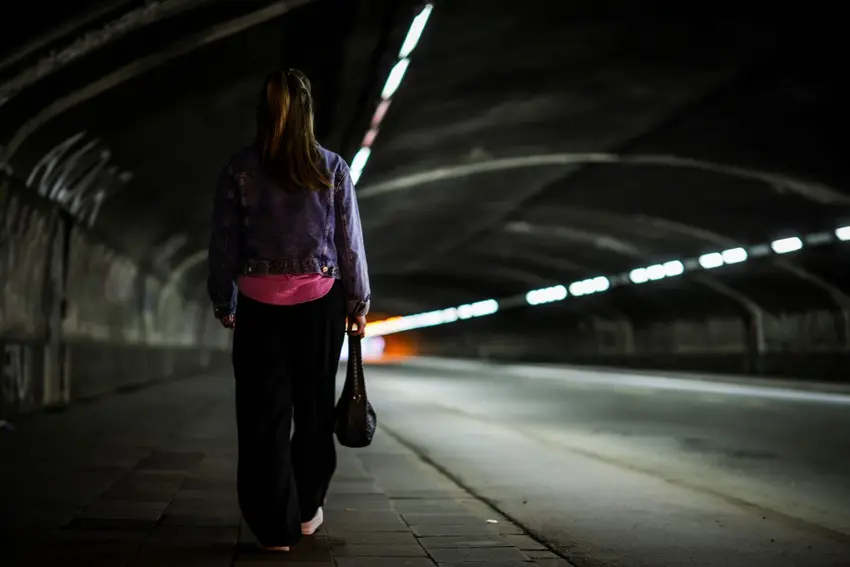
A new survey has revealed that a majority of women in Germany do not feel safe in public spaces, with only 14 percent saying they feel secure in clubs and train stations.
This headline finding comes at a time when the issue of safety in German cities is dominating national debate, fuelled by recent political statements and, most recently, a high-profile open letter from 50 prominent women calling for concrete action.
Survey reveals widespread unease
The poll, conducted by the opinion research institute Civey for the Funke Media Group, questioned 5,000 people aged 18 and over between 23 and 27 October.
It found that 55 percent of women do not feel safe in any of the public places listed on the survey, which included streets, public transport, and parks.
Clubs and train stations were identified as the least safe, with only 14 percent of women feeling secure there.
READ ALSO: What to know about dealing with domestic violence in Germany
The sense of insecurity in German cities is not limited to women. Nearly half (49 percent) of all respondents – including men – reported feeling unsafe in all of the public spaces mentioned.
Why is this topic so prominent in Germany at the moment?
The debate about safety in public spaces has become particularly heated in Germany following recent comments by Chancellor Friedrich Merz of the conservative Christian Democrats (CDU).
Merz linked problems in German cities to migration policy, suggesting that increased deportations could improve safety.
“But of course we still have this problem in the cityscape, which is why the federal interior minister is now working to enable and carry out deportations on a very large scale,” he said.
Asked to clarify his comments, Merz said, “If you have daughters, ask them what I might have meant by that. I suspect you’ll get a pretty clear and straightforward answer."
His remarks have been widely criticised and sparked demonstrations, as well as broader discussions about the state of public life in urban areas.
Now, 50 women from different backgrounds, all prominent in either the arts, science, politics or civil society in Germany, have sent an open letter to Merz urging him to take meaningful action to protect women.
READ ALSO: TELL US - What do you think about the German chancellor's 'Stadtbild' remarks?
The letter criticises the way the debate has been framed, stating: "We would like to talk about safety for daughters, i.e., women. However, we want to do so seriously, and not as a cheap excuse to justify racist narratives."
The signatories include Green Party politician Ricarda Lang, climate activist Luisa Neubauer, singer Joy Denalane, author Alice Hasters and economist Isabella Weber. The women represent a cross-section of influential voices in German public life.
The letter argues that the current discussion pits victims of sexism against victims of racism, and accuses the chancellor of using women’s vulnerability as a pretext to stir up resentment against people with a migrant background in Germany.
READ ALSO: Cologne launches night-time taxi vouchers to help women get home safely
Ten concrete measures proposed
Rather than focusing on deportation as the solution to problems facing many German cities, the letter suggests ten practical steps the government could take to improve safety for women:
1. Better prosecution of sexual and domestic violence
2. Improved lighting and surveillance of public spaces
3. Inclusion of femicide in the law
4. Reliable data collection on violence against women
5. Adequately funded women’s shelters and safe houses
6. Funding for the Protection Against Violence Act and recognition of racially motivated violence
7. Protection against digital violence and racism on the internet
8. Introduction of the right to physical self-determination through a reform of abortion law
9. Strengthening women’s financial independence
10. Combating poverty among older women
Comments