
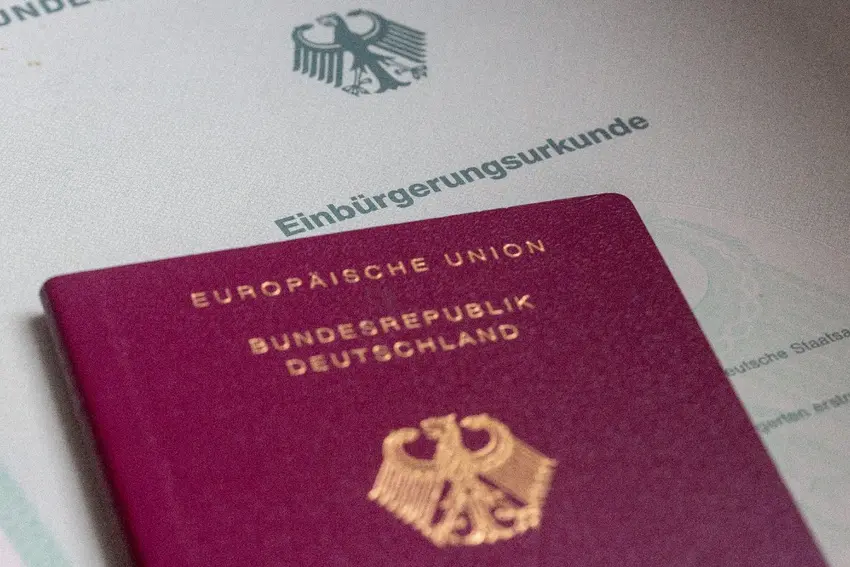
The German parliament (Bundestag) is set to vote on government plans to scrap the path to German citizenship after three years on October 8th.
This option is available to foreign residents who have C1 level German and can prove they are exceptionally-well integrated.
In future, residents will only be able to naturalise on the standard route, which involves having five years of residence and B1 German.
READ ALSO: German parliament sets date for vote on future of three-year citizenship
The law change, a compromise between the centre-right conservatives (CDU/CSU) and their junior coalition partners, the centre-left SPD, is expected to win majority support in both the Bundestag and the Bundesrat, which represents German states.
Politicians had been considering whether to implement a grace period where people who had submitted their application would still be able to naturalise until a certain date even if the law had changed
Now The Local can reveal that no such option is planned. This means applicants will not be able to receive their naturalisation certificate if the law changes while their application is still being processed.
However, sources have told The Local that citizenship offices will not outright reject applicants in these circumstances. Instead, applications will be placed on hold until residents have gained five years of residence.
This means applicants will not face a new waiting period and extra costs which would be the case if their documents were thrown out, and they had to apply again at a later date.
Sends the wrong message
Not many people will be affected by the law change. Very few foreigners qualify to apply via via the three-year route because the requirements are so high.
However, internationals and labour experts say that getting rid of fast-track citizenship, which rewards those who work hard to integrate into German society at a quicker pace, sends the wrong message, and could have a negative effect on the country's efforts to attract skilled workers from abroad.
READ MORE: 'Turbo-German studying' - an American in Berlin on the race to qualify for three-year citizenship
The three-year option was brought in during sweeping naturalisation reforms in 2024. Among the other changes were dual citizenship for all and being able to apply for German citizenship after five years instead of the previous eight years.
But right-leaning politicians, including now Chancellor Friedrich Merz, of the CDU, repeatedly called for the reforms to be reversed. The three-year option, dubbed "turbo citizenship" by critics, was singled out as failing to guarantee sufficient integration.
Hakan Demir, MP for the Social Democrats, told The Local that that the expected law change was a "good compromise".
"Almost all progressive reform components will stay in place: dual citizenship, naturalisation after five years, more flexible language requirements for the guest worker generation," he said.
Demir added that the focus should turn to speeding up waiting times and creating a welcoming atmosphere for people becoming German.
"With the end of the fast-tracked naturalisation process after three years, we will hopefully focus on implementation," he said.
"Waiting times are still too long. And we should be more respectful towards new Germans. Settling in a new country is not easy. Neither is the fulfilment of the naturalisation requirements."
READ ALSO: Which German cities have the longest times for citizenship
Comments