

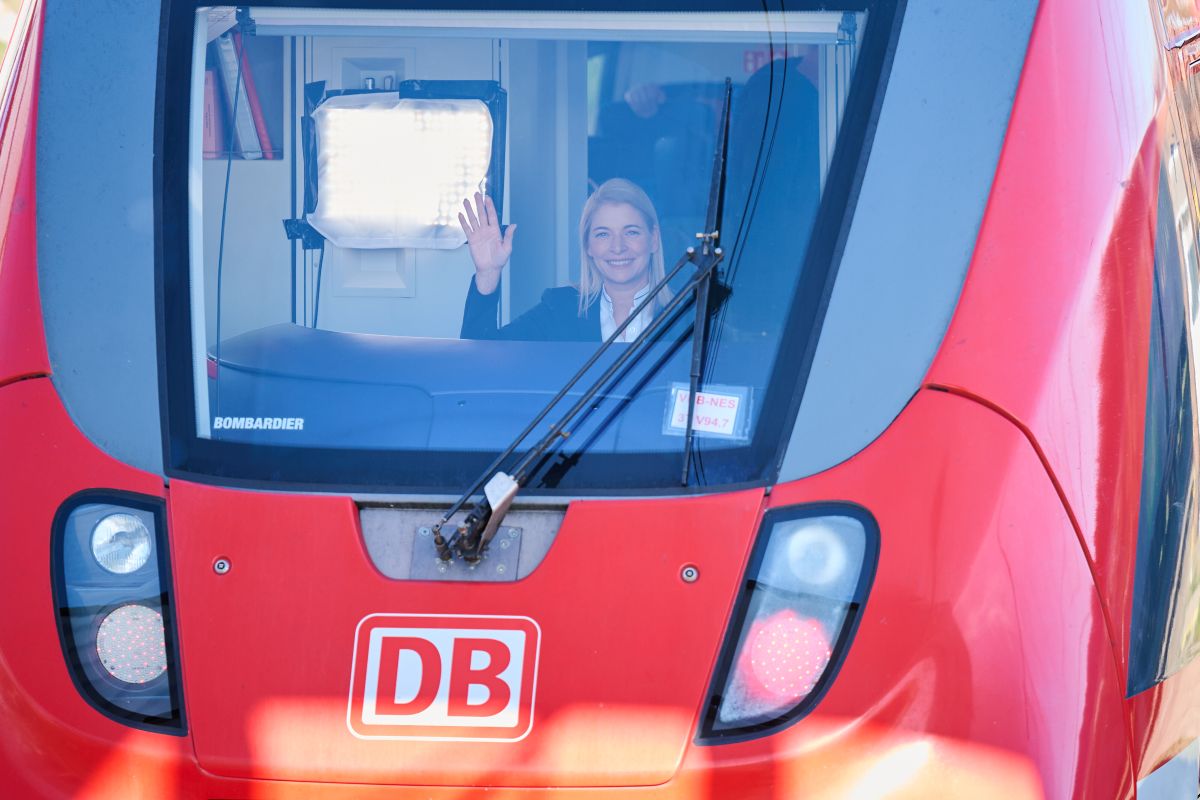
So it’s official: the new head of Deutsche Bahn is Evelyn Palla.
After years of ever-longer delays, declining on-board service, and sharp fare increases, rail passengers are desperate to see improvement. Perhaps heads rolling at the top and bringing in a fresh face will help?
Yet anyone looking forward to the ‘new start’ Palla promised at her press conference this week would do well to check their expectations.
For, in truth, the failings of recent years cannot be wholly – or even primarily – blamed on her predecessor Lutz. Or his predecessor Rüdiger Grube. Or his, Hartmut Mehdorn.
No: whoever is made Fat Controller, this is not the sunny Island of Sodor, where the worst that can happen is an encounter with a few troublesome trucks. In Germany, Thomas the Tank Engine & Friends are running on a wildly-complex, direly under-funded network which has been made the way it is by decades of political negligence.
It is a mess which will, similarly, take decades to fix.
READ ALSO: Switzerland suspends Deutsche Bahn trains due to chronic delays
However gleaming Palla’s CV, she faces three intractable, interlinked problems. Problems which have dogged those who have gone before her. And against which, she too will be able to achieve little on her own.
These problems are: complexity, privatisation, and political will.
For a start, German rail is far more complex than most people think. Everyone complains about die Bahn and thinks of DB.
But conceiving of DB as being ‘German railways’ in the same way as, say, SNCF in France, RENFE in Spain, or, for us older Brits, British Railways is a category error. In fact, like British Railways, Deutsche Bundesbahn was consigned to the history books in 1994, when it was renamed Deutsche Bahn and its remit drastically altered.
Privatised complexity
Instead of a single state-run entity responsible for running the entire railway, it became a private company, wholly owned by the state and split into various arms: infrastructure, stations, intercity operations, regional services, freight...
What's more, to keep DB on its toes (and to conform to EU competition law), the rail network was opened to other operators and the German states (Bundesländer) were told to put regional services out to competitive tender. The best (read: lowest) bid would get the franchise.
The big idea? DB would be forced to get more efficient and grow, eventually paying dividends into state coffers rather than drawing from them.
If that all sounds crazy, that’s because it is.
Like roads, railways never pay dividends: they are costly, but necessary elements of an industrial economy. But such was the free-market logic of the 1990s.
Predictably enough, what actually happened was that low-cost private bidders moved in on high-volume, easy-to-operate short-distance routes, wildly undercutting DB (whose existing workforce was still on public-sector pay-scales) while steering clear of unattractive and complex long-distance and freight systems.
Meanwhile, with Berlin politicians breathing down its neck to cut costs, DB started sucking money out of maintaining infrastructure and rolling stock, funnelling it into buying overseas companies in an effort to get big and float on the stock exchange.
Public irresponsibility
The Financial Crisis of 2008 should have put an end to that dream, but that was still kept alive by a succession of autobahn-focussed CSU transport ministers. Despite mounting evidence to the contrary, they still expected DB to start turning a profit at some point and that everything would be tickety-boo.
The biggest failing of the DB CEOs in those years – Mehdorn, Grube, and Lutz – was not that rail transport got worse. Considering that they were expected to find savings in their network while expanding a nationwide service for a growing number of customers, it’s actually to their credit that anything is still working at all.
Their real culpability lies in not having challenged the orthodoxy.
Sure, there were some briefings and, if you knew how to read between the lines in interviews, some warnings about the limits of what could realistically be expected.
Yet at no point did any of them make a stand. At no point did any of them call out Berlin politicians on the myths they were peddling. That was left to the likes of strike-happy moustachioed hothead Claus Weselsky at the drivers’ union (remember him?).
Instead, all three trousered their pay and pretended that, somehow, some way, they would be able to keep things running – or, later, to get things back on track. In fact, so wedded was Lutz to the prevailing Berlin orthodoxy that he failed to notice it change in 2021.
With Volker Wissing, who took over in that year, Germany got its first transport minister in decades who gave the railways more than a passing thought.
And now, with the debt brake scrapped, DB will finally get funding sufficient to make headway renewing the run-down network.
Prospects for improvement – or danger on the line?
So Evelyn Palla is coming into the job at a propitious moment: if she can stay for as a long as each of her predecessors, improvements should become noticeable towards the end of her tenure.
Yet caution is advised. For all the Sondervermögen splurge, DB is still only being accorded annual settlements. There is no guarantee that investment at current high levels will survive the axe set to swing over future budgets.
READ ALSO: Germany's massive infrastructure plans demand more foreign workers
So she may need to be louder and more uncomfortable than previous rail bosses to make sure ministers honour the commitments made once the news cycle has moved on.
Worse, there is still no sign that Berlin intends to make real changes to the system as it stands.
DB will still be caught between competition in regional franchises and expectations to provide a functioning nationwide service – all on the same under-dimensioned network. (There is only funding for repairs, no expansion.)
Palla will be expected to rebuild infrastructure, but will be criticised for setting running fees to high. She will also be expected to keep ticket prices for passengers down – as well as losses for the company.
It’s the management equivalent of squaring the circle. And ultimately, the fate of Deutsche Bahn and rail travel in Germany is not in the hands of one person at the top. Rather, it is a matter for the Transport Minister, the Finance Minister, and the millions of voters for whom the state of our railways was never a priority until it became too parlous to overlook.
So we long-suffering passengers can do little else than to wish the new Fat Controller well – and try not to lay the blame wholly at her feet if things go awry.
Comments