

Healthcare in Germany is getting more expensive.
At the start of this year, long-term care insurance (Pflegeversicherung) contributions for statutory health insurance rose to 3.6 percent, while the recommended ceiling for additional health insurance contributions was raised from 1.8 percent to 2.5 percent.
Politicians and health insurance companies blame a financial black hole in Germany's health system brought on by rising costs of medicine and care, as well as the country's aging population and the Covid pandemic.
At the same time, dissatisfaction in healthcare – particularly for specialist services – is growing. The vast majority of the population in Germany – around 90 percent – are insured under the public (statutory) health insurance system, while the rest have private coverage.
A survey carried out this year by Germany's biggest health insurance provider Techniker Krankenkasse (TK) found that 38 percent of respondents were unhappy with specialist doctor services in Germany, compared to a 27 percent dissatisfaction rate in 2017.
In comparison, only 18 percent of respondents said they were unhappy with care from primary doctors or GPs, according to a spokesperson from TK.
The 'TK-Meinungspuls' representative survey also revealed that 62 percent of respondents are unhappy with waiting times for specialist appointments, compared to 50 percent in 2017.
Do publicly-insured patients really have a longer wait for appointments?
Waiting times for a doctor appointment depend on several factors including; where you live, what kind of care you're looking for and what kind of insurance coverage you have.
Whether and to what extent private patients are given preferential treatment when it comes to appointments is a hot topic in Germany, and has been for a long time.
Earlier this year, the Association of Statutory Health Insurance of Physicians (KBV) maintained that privately insured patients do not get preferential treatment, arguing there are simply too few of them in Germany to block appointments. However, the National Association of Statutory Health Insurance Funds (GKV) says there is clearly unequal treatment and has called for change.
READ ALSO: The big healthcare changes in Germany in 2025
It is difficult to find any official statistics on waiting times for appointments. However, an analysis by German news outlet Spiegel, focusing on data from the online appointment provider Doctolib, provides key insights. The data suggests there are major waiting times for specialist doctors for those with public insurance.
How long does it take to get a doctor's appointment in Germany?
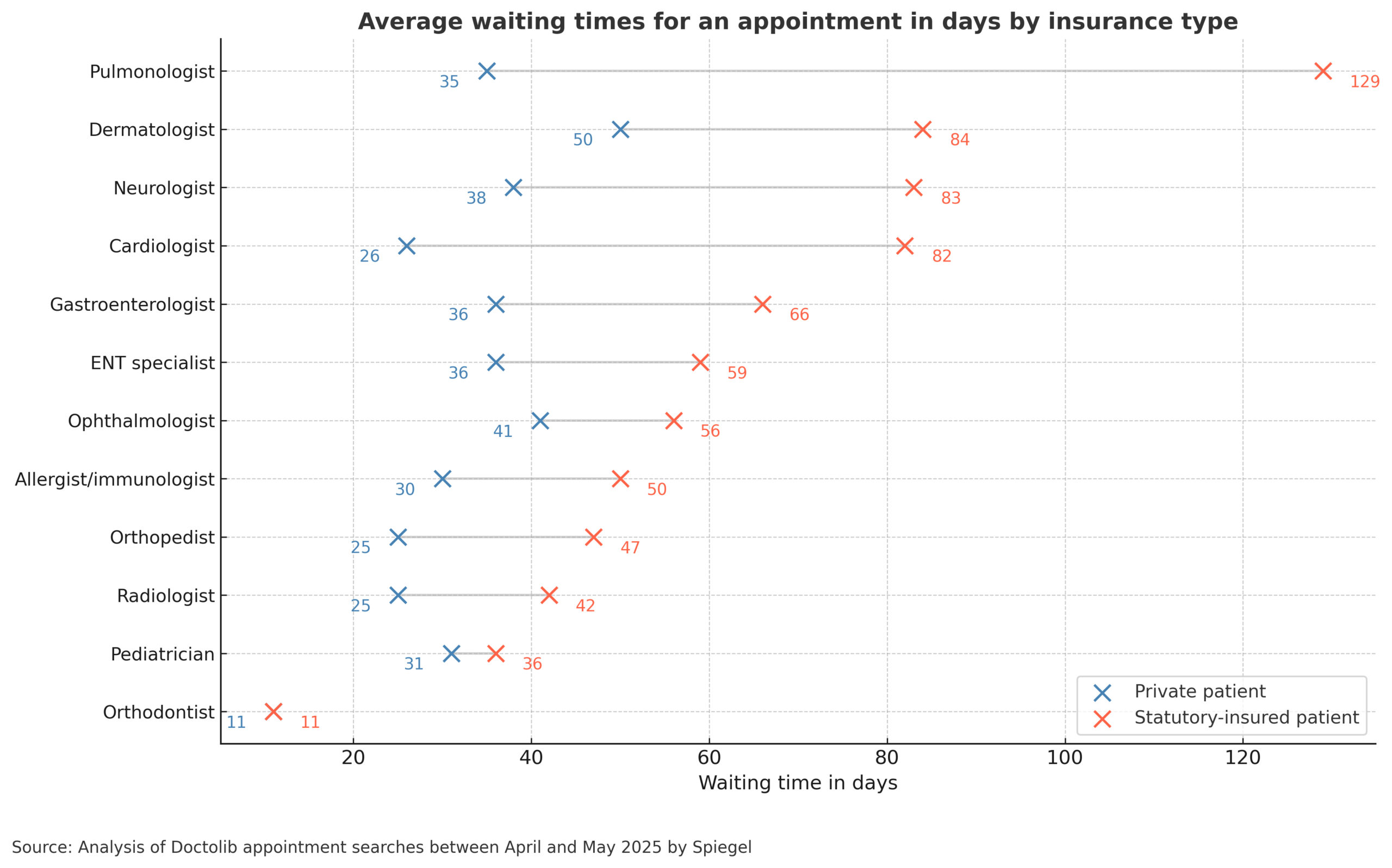
According to the report, which checked through 24,000 search results on the platform, public health insurance patients in Germany have to wait on average about twice as long for an for an appointment as privately insured patients, and in some cases the waiting time is three or four times as long.
This is the case, for example, with pulmonologists (Lungenfacharzt), doctors who specialise in lung conditions. On average, patients with statutory health insurance wait 129 days, or more than four months, for an appointment, the study found. Private patients, however are seen much faster, with a waiting time of about 35 days.
Meanwhile, for a dermatologist (Hautarzt), the average appointment waiting time for private patients is 50 days, compared to 84 days for people with statutory health insurance.
There was no difference found in waiting times for an orthodontist appointment. However, it's worth pointing out that it is very rare for orthodontic treatment to be covered by statutory health insurance in Germany. Patients will usually have to pay out of their pocket for the service.
Here's a chart based on data from the Der Spiegel study, which we compiled, showing average specialist doctor waiting times (in days) for privately-insured patients, and statutory-insured patients in Germany.
Can access to appointments be improved?
Making it easier for publicly-insured patients to get appointments in Germany is on the minds of health providers.
The spokesperson from TK told The Local, "The topic of doctor visits and waiting times for those with statutory insurance is a very important one for TK.
"As Germanys biggest health insurance [provider] we address this issue at various levels to ensure that statutory insured persons have faster and better access to the care that best suits their needs."
They added that TK is "committed to improving access to medical care at the political level" and is in constant dialogue with politicians.
Meanwhile, a spokesperson from Doctolib told us: "Our goal is to make medical care faster and easier to access for everyone, regardless of their insurance status
"We are already succeeding in this today: 44 percent of paediatrician appointments and 42 percent of family doctor appointments take place within 48 hours of being booked via Doctolib."
The appointment platform said that it also aims to make sure cancelled appointments are given to people who need them as soon as possible.
"In 2024 alone, we were able to reallocate 3.36 million cancelled doctor's appointments using our digital waiting list function," the spokesperson added. "This means that appointments that would otherwise be lost can be offered to other patients at short notice.
"In January 2025, every practice in Germany filled half of all cancelled appointments on average: one-third of the available appointments were reallocated within two hours, and half within 12 hours."
Doctolib said their digital waiting list allows "400,000 hours of treatment time to be put to good use instead of being lost".
"Those with statutory health insurance benefit particularly from this, as it is often more difficult for them to get doctor's appointments at short notice," the spokesperson added.
READ ALSO: Healthcare in Germany - how to get a faster appointment with a specialist doctor
Comments (1)