
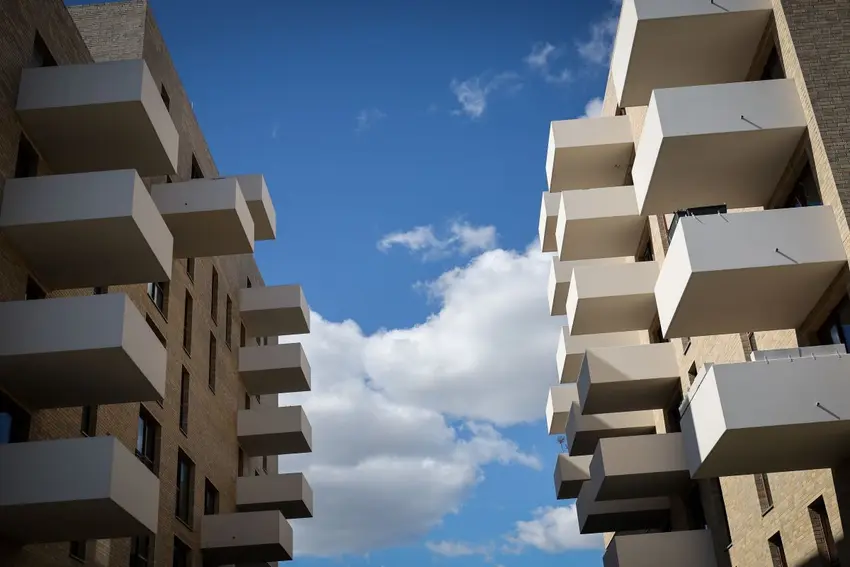
Germany is still a nation of renters. According to the country’s statistical office (Destatis), more than half of residents (52.8 percent) lived in rental accommodation in 2024, the highest proportion of renters among EU nations by a significant margin.
With rental markets overheating in many parts of Germany – and newcomers to the country often at a disadvantage due to the language barrier, a lack of familiarity with the country, and even discrimination – securing a long-term rental contract at a reasonable price remains a top priority.
The latest insights from the "Postbank Wohnatlas 2025", developed with research from the Hamburg Institute of International Economics (HWWI), shed light on how rental costs and housing affordability vary across Germany’s regions.
What proportion of income do Germans spend on rent?
Data from the Postbank Wohnatlas shows that, on average, tenants in Germany spend 14.1 percent of their net household income on the cold rent (Kaltmiete) for a 70-square-meter apartment, a slight increase from 13.9 percent in 2023.
For the purposes of comparison, homeowners with mortgages devote an average of 18.3 percent of their net income towards paying off the principal and interest payments, a slight decline from 19.2 percent the previous year, due to falling property prices.
EXPLAINED:
- Why renting is still cheaper than buying in Germany
- How much do you need to earn to buy a home in Germany?
Financial experts generally recommend that individuals avoid spending more than 30 percent of their net income on rent and associated housing costs, such as heating and maintenance, to ensure financial stability.
According to the German Tenants' Association, additional housing costs (or the 'Warm' in Warmmiete) currently average €3.15 per square metre in Germany, equating to around €220 monthly for a 70-square-meter flat.
In addition, research from The Information Service of the German Economic Institute (IWD) reveals that full-time foreign workers in Germany earn a median gross salary of approximately €3,030 per month, compared with €3,950 for native German workers.
Affordable rural areas and pricey city centres
In many rural parts of Germany, particularly in the eastern states, living costs are considerably lower. The Vogtland district in Saxony boasts the lowest rent per square metre – just €6.48 – with total rent including utilities around €587 for a 70-square-meter apartment.
To afford this while adhering to the 30 percent rent-to-income guideline, an individual tenant will need to earn a gross annual salary of about €34,900 (approximately €2,900 a month).
By contrast, Munich is among the priciest cities for renters, according to a report by Focus Online. A 70-square-metre apartment in the Bavarian capital costs an average of €1,700 including utilities.
Following the 30 percent rule, tenants there would need a net monthly income of approximately €5,642 to cover rent comfortably – a gross equivalent of nearly €10,000 a month or more than €120,000 annually.
Germany’s rental hotspots
Across the country, there are 13 regions where renters would need to earn more than €82,000 in order to avoid spending more than 30 percent of net income on a 68-square-metre apartment.
In addition to Munich and nearby areas Starnberg and Fürstenfeldbruck, the list includes Frankfurt am Main, Stuttgart, Berlin, Dachau, Ebersberg, Miesbach, Freiburg im Breisgau, Heidelberg, and Cologne.
READ ALSO: Almost all rents in Berlin found to be illegally high
The Wohnatlas also suggests that income in the region of €70,000 is necessary to live comfortably in Leipzig, Bremen, Hanover, Jena, Trier, and Koblenz, for tenants in 68-square-metre apartments.
Affordable city alternatives
For renters with lower incomes, cities like Chemnitz offer a more affordable option.
Here, a gross salary of approximately €37,000 per year enables renting a 68-square-meter apartment within the prudent 30 percent rent-to-income threshold.
READ ALSO: The hidden costs of renting in Germany
Other budget-friendly locales include Gera in Thuringia (€38,200), Wilhelmshaven in Lower Saxony (€42,600), and the cities of Gelsenkirchen and Magdeburg (both around €42,900).
Most eastern German states, with the exception of Brandenburg, host only a few cities where residents need to earn above the national average to afford typical rents. Saxony-Anhalt stands out as one of Germany’s most cost-accessible regions.
Comments (1)