

Migration expert: Germany well ahead in integrating refugees
Ten years after the arrival of large numbers of refugees in 2015, Herbert Brücker, migration expert at the Institute for Labour Market and Occupational Research (IAB) at the Federal Employment Agency, has drawn a positive conclusion. “Together with Norway, we are quite far ahead – and significantly better than Denmark, the Netherlands, and Italy,” Brücker told the Handelsblatt newspaper.
Germany could have done even better if it had not made the mistake of distributing refugees disproportionately to structurally weak regions with high unemployment, added Brücker.
Among the men who arrived in Germany in 2015, the employment rate is now above the German average, Brücker told the newspaper. A clear majority earn their own living and more than half work as skilled workers or at a higher level.
“The real level of qualification is much higher than the often non-existent formal qualifications suggest – and higher than many Germans still believe,” said Brücker.
The structure of the refugees' jobs in their home countries was very similar to that in Germany, he said, only the educational pathways were completely different.
READ ALSO: Expert tips for your next appointment at a German immigration office
In Germany, for example, someone working in retail usually has commercial training. “That didn't exist in Syria or Iraq, but in fact people did the same or similar work.”
The number of cars in Germany continues to rise
The number of cars on Germany’s roads keeps rising. At the start of 2025, a record 49.3 million passenger vehicles were registered across the country, according to the Federal Statistical Office citing data from the Federal Motor Transport Authority (KBA).
Car ownership is also hitting new highs. There are now 590 passenger cars for every 1,000 residents in Germany, meaning that, statistically, more than half the population owns a car.
Saarland has the highest car density in the country at 646 cars per 1,000 people. Other states with high car ownership include Rhineland-Palatinate and Bavaria, while Brandenburg, Saxony, Saxony-Anhalt, Thuringia, and Mecklenburg-Western Pomerania all sit below the national average.
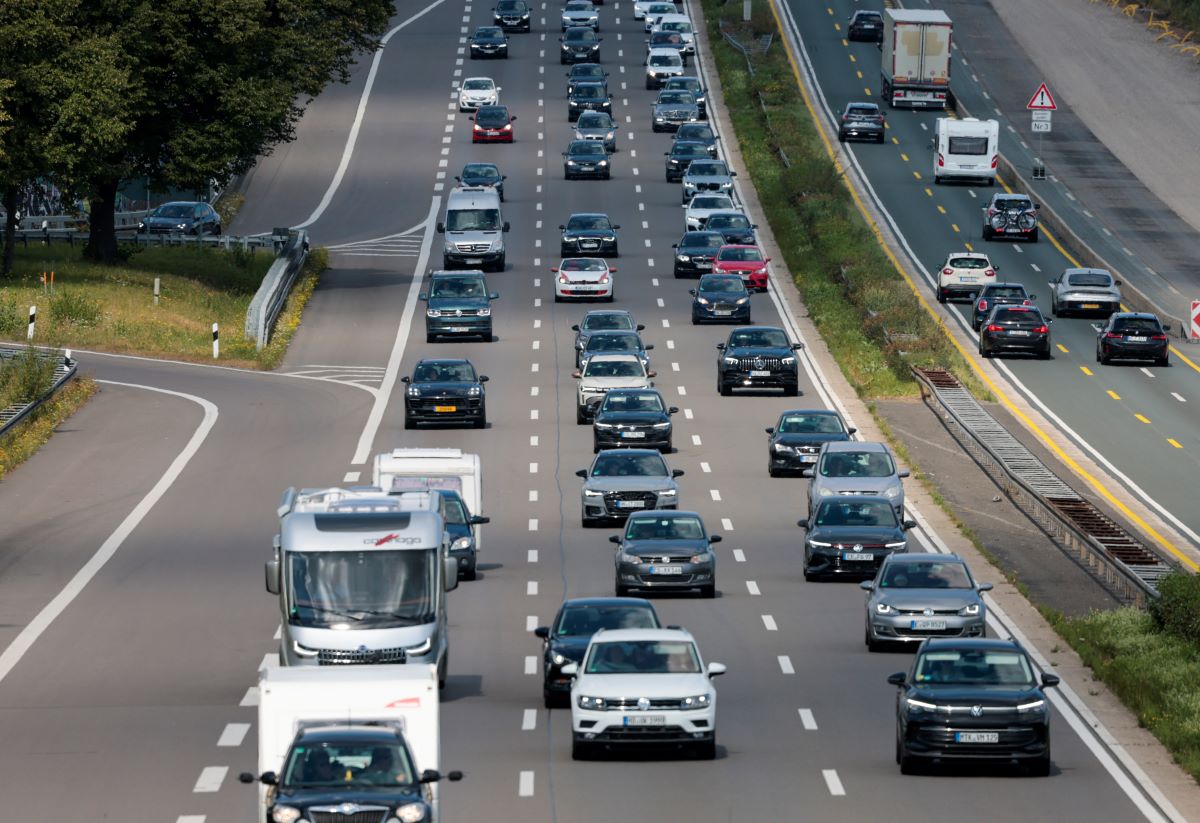
Berlin, by contrast, has just 334 cars per 1,000 people. The number is about 100 cars higher in Bremen and Hamburg.
READ ALSO: The essential vocab you need for driving in Germany
The shift toward electric mobility is beginning to show in the statistics. At the start of 2025, purely electric vehicles made up 3.3 percent of all registered passenger cars – a slight increase from the previous year. However, the share of fully electric vehicles among newly registered cars is growing more quickly: in the first half of 2025, electric vehicles accounted for 17.7 percent of all new registrations.
According to the latest environmental economic data, the steady rise in car ownership has not resulted in a continuous increase in CO₂ emissions. In fact, road traffic emissions in 2025 were roughly unchanged compared to the previous year and almost 14 percent lower than in pre-pandemic 2019.
Germany to receive millions in aid from Norway for Patriot systems for Ukraine
As part of joint military aid for Ukraine with Germany, Norway announced on Sunday that it would contribute the equivalent of almost €600 million towards providing Ukraine with two complete Patriot air defence systems.
The systems are currently in Germany and will be delivered to Ukraine “as soon as possible,” it said.
According to the information provided, the US will replace the Patriot systems that are being handed over, and Norway will contribute financially to the replacement as part of its multi-year aid package for Ukraine.
READ ALSO: Germany to start deliveries of two Patriot systems to Ukraine
US President Donald Trump, who had long refused to supply weapons to Ukraine, announced in July that Patriot defence systems would be delivered to the country. However, European countries such as Germany would pay for the Patriots.
At the time, the German government announced that it would purchase two Patriot systems worth a total of €2 billion from the US for onward transfer to Kiev.
Visitors bid farewell to mini hippo Toni before he travels from Berlin to France

Visitors came in droves to Berlin Zoo to say goodbye to the young pygmy hippopotamus before his move to a new zoo in Mulhouse, Alsace, France.
During Toni's last week in Berlin, the zoo offered a special program every day at 1:30pm so that his fans could see him in action one last time.
One fan even travelled from Prague, according to a zoo spokeswoman. “We didn't expect such a turnout for Toni Time,” she said.
Toni has also become an internet star over the past 15 months. Video footage of the tiny hippo shortly after his birth in early June last year went viral.
Having asked for help giving the baby hippo a name, the zoo received more than 20,000 suggestions from all over the world. Toni eventually named after football player Antonio Rüdiger, who became his honorary godfather.
Since Toni's birth, the zoo's Instagram community has grown from 125,000 to over 254,000 people worldwide, according to the spokeswoman.
“Toni was able to draw attention to a species that has rarely been in the spotlight before,” she explained.
The Bundesliga returns in Germany
The Bundesliga kicked off the 2025/26 season at the weekend. Defending champions Bayern Munich began their campaign in style, demolishing supposed title challengers RB Leipzig with an emphatic 6-0 win at the Allianz Arena. The dominant victory sends a clear message: Bayern look as strong as ever, and early signs point to another season with the perennial champions as heavy favourites.
READ ALSO: How to watch Bundesliga games on TV in Germany
Two teams are back in the Bundesliga this year. Hamburg, making their long-anticipated return to the top flight, drew 0:0 against Mönchengladbach, while Bundesliga 2 champions Cologne secured a 1:0 victory away at Mainz.
Among Bayern's most likely title challengers, Leverkusen lost 2:1 at home to Hoffenheim and Stuttgart lost 2:1 away to Union Berlin.
With reporting by AFP and DPA.
Comments