
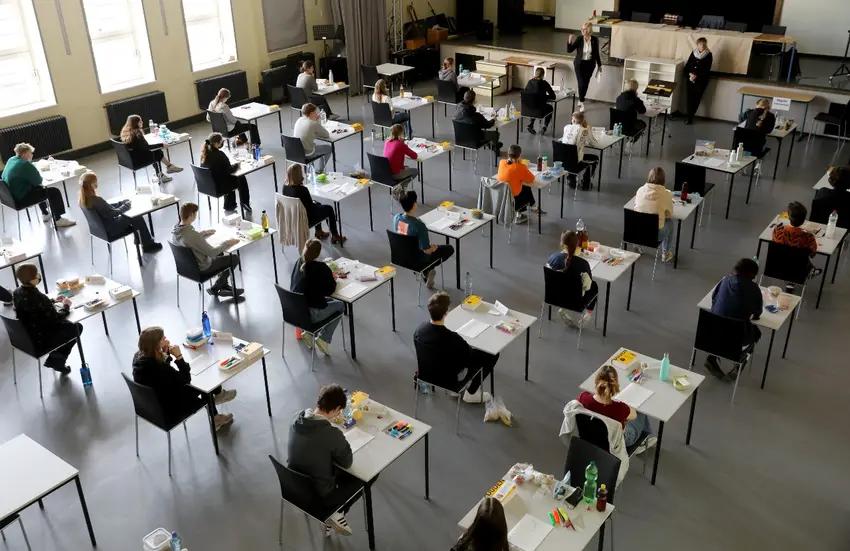
In Germany, education decisions largely lie with the states – that's why there are often different rules on schooling depending on where you live.
In general, it is mandatory for German students to attend school for a minimum of nine years starting from the age of six.
All children attend elementary school (Grundschule) for four years, and then they transfer on to one of a few different options for secondary schools. Altogether this typically amounts to nine or ten years of schooling by the time the student is 18.
Pupils attending the Gymnasium (a grammar school or high school) can leave after completing the twelfth or thirteenth grade (depending on the state) and passing their final exam (known as an Abitur).
North Rhine-Westphalia (NRW) is in the process of making big changes to its education system.
In NRW, the number of compulsory years that pupils attending a Gymnasium have to complete is being extended from eight to nine years. The move represents a switch back to the 'G9' system, rather than the 'G8'.
READ ALSO: What parents in Germany should know about the planned schools shake up
In the German school system, from their fifth year pupils are funnelled off into different types of schools, depending largely on their academic achievement and parents’ final say. These will typically be either Gymnasium, or Hauptschule or Realschule. In the latter two types of schools students take vocational classes combined with vocational training.
Around 30 percent of German secondary school pupils attend a Gymnasium, which is generally considered to be more academic-oriented and prepares children for their school-leaving certificate, and which generally leads to a university education.
What does the change mean – and why is it significant to Germany?
The decision by NRW, home to cities such as Cologne, Düsseldorf and Münster, to switch from eight years of grammar schooling to nine was made several years back following intense discussions among both the public and policymakers.
Schools in the region began transitioning to the nine-year model (G9) from the 2019/20 school year. The first cohort to fully be part of the new G9 process will be those who graduate with their Abitur in 2027.
It means that in 2026 across NRW there will be no graduating Abitur class, creating a one-year gap. About 44,000 fewer students will finish school with the Abitur.
This move is actually connected to a wider debate about education in Germany.
Traditionally, Gymnasium students in Germany spent nine years (grades 5–13) before earning their school leaving certificate.
Around the 2000s, many states shortened this to eight years (grades 5-12). It meant students got their Abitur one year earlier. The main goal was to align Germany with international standards and allow students to enter university or go into training for a job sooner.
However, the G8 system was highly controversial, with some German media outlets, such as Der Spiegel, dubbing it 'Turbo-Abi'.
Those against it said it caused stress and overload for students, while supporters of it argued it gave students a faster path to university and into the workforce.
Ultimately the backlash has resulted in several states switching back, or starting the process of switching back, to the G9 system.
G8 did not find 'lasting acceptance'
NRW's schools ministry says: "The debate about the length of the Gymnasium education programme has shaped the debate on education policy in North Rhine-Westphalia – as in other federal states – for almost 20 years, with varying degrees of intensity.
"After the introduction of G8 in 2005, its practical implementation did not find lasting acceptance in schools and among the public. This has led to increased political and civic activity, especially since 2015."
The schools ministry said that all high schools who "had not actively spoken out in favour of retaining G8" have been returning to G9 since the 2019/20 school school.
"With this central reform, the state government has followed the wishes of most pupils, parents and teachers," the ministry added.
The state government is also in the process of modernising.
"The core curricula for grammar schools were extensively revised and adapted to the conditions of a digitalised world," says the education ministry.
Comments