
Verdi to hold crunch talks on public sector pay
After a mediation committee issued its recommendations last week, services union Verdi will meet for a fourth round of talks on April 5th to thrash out a deal on public sector pay and conditions.
For several weeks, the union has been negotiating with local and federal government officials on behalf of some 2.5 million public-sector workers in Germany.
The talks have been punctuated by regular warning strikes, including in refuse collection, kitas, clinics and on public transport. However, the two sides have so far been unable to reach an agreement and enlisted the help of arbitrators on March 17th.
On Friday, the mediators issued recommendations for a three percent pay rise from April 1st, with a further 2.8 pay rise from May 2026.
Those who do not work in clinics or nursing homes would be able to swap parts of their annual bonus for extra days off, and all employees would receive an extra day's holiday from 2027.
So far, the negotiating parties have been tight-lipped on the proposals, which will be the subject of the next round of talks in Potsdam on Saturday and Sunday.
If the two sides cannot agree, Verdi can hold a members' ballot to decide on unlimited strikes.
READ ALSO: What happens next after Berlin's two-day public transport strike?
Germany making 'progress' against irregular immigrants
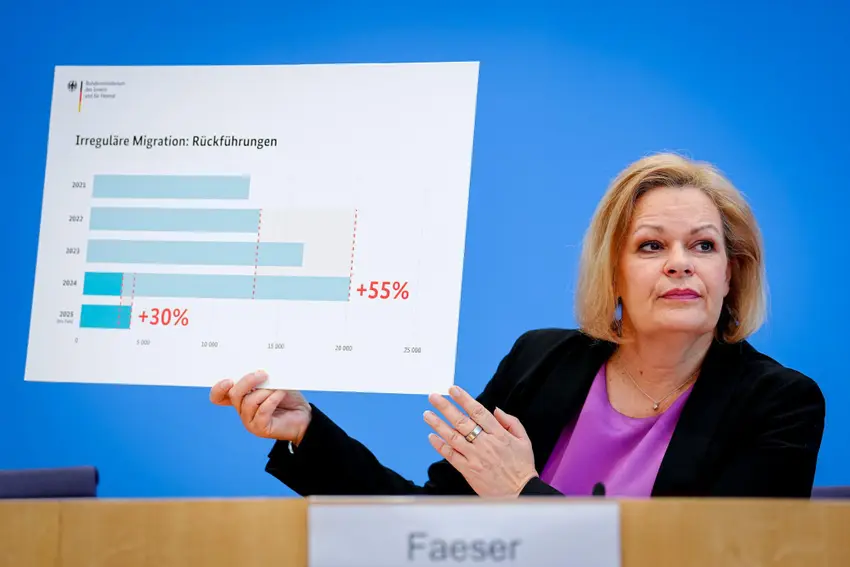
Tighter controls in Germany in recent years have succeeded in limiting irregular immigration, the Interior Ministry announced on Tuesday, highlighting lower asylum applications and boosted deportations.
The country has made "significant progress" on the issue under the outgoing government of Chancellor Olaf Scholz, Interior Minister Nancy Faeser explained.
"The figures speak for themselves," she said, adding that the number of asylum applications in the first two months of this year was 43 percent lower than for the same period last year, and 51 percent lower than for that period in 2023.
There were 229,751 asylum applications in January and February, she said.
The number of deportations has also increased consistently since 2021, according to ministry figures, to over 20,000 last year.
Anger over migration flared in the run-up to Germany's election in February, with the far-right AfD making big gains after a series of attacks blamed on asylum seekers.
READ ALSO: Germany's far right targets greater influence in new parliament
The CDU/CSU's victorious candidate to be chancellor, Friedrich Merz, promised a radical crackdown on migration when he campaigned for the election. He proposed that all undocumented foreigners be turned away at the border.
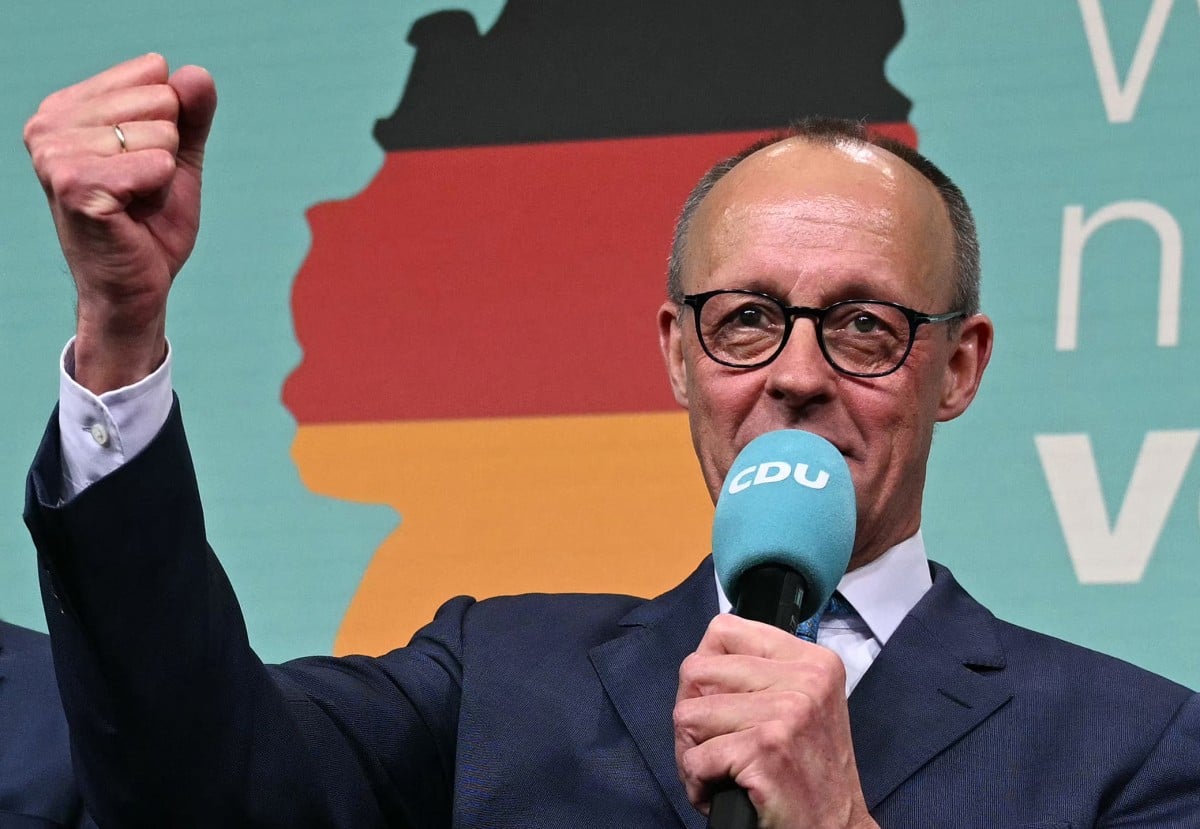
However, the topic has become a sticking point in coalition talks with the centre-left SPD, who want to co-ordinate Germany's approach with neighbouring countries first.
Germany already applied checks along its border with Austria since 2015, and in 2023 extended them to its borders with Poland, the Czech Republic and Switzerland.
Since September 2024, controls have also been applied at all of Germany's other land borders, with France, Luxembourg, Belgium, the Netherlands and Denmark.
READ ALSO: Pensions to taxation - Where Germany's future coalition still disagrees
EU lifts lawmaker's immunity over Nazi salute image
The European Parliament has lifted the immunity of a German far-right lawmaker facing prosecution in his home country for sharing a photo montage of a Nazi salute.
Fellow EU lawmakers stripped Petr Bystron of his protection from prosecution during a plenary session in Strasbourg.
Bystron, of the far-right Alternative for Germany (AfD), is being investigated over a social media post he shared in 2022 after the dismissal of Ukraine's ambassador to Berlin.
"German politicians wave goodbye," he wrote on Twitter, now X, as the caption to a photo montage of politicians with their arms outstretched in what resembled Nazi salutes.
A lawmaker in the German Bundestag at the time, Bystron was elected to the European Parliament in 2024. In a separate case last year he was forced to deny allegations he accepted money to spread Russian propaganda.
Putin stalling on Ukraine talks, says Foreign Minister
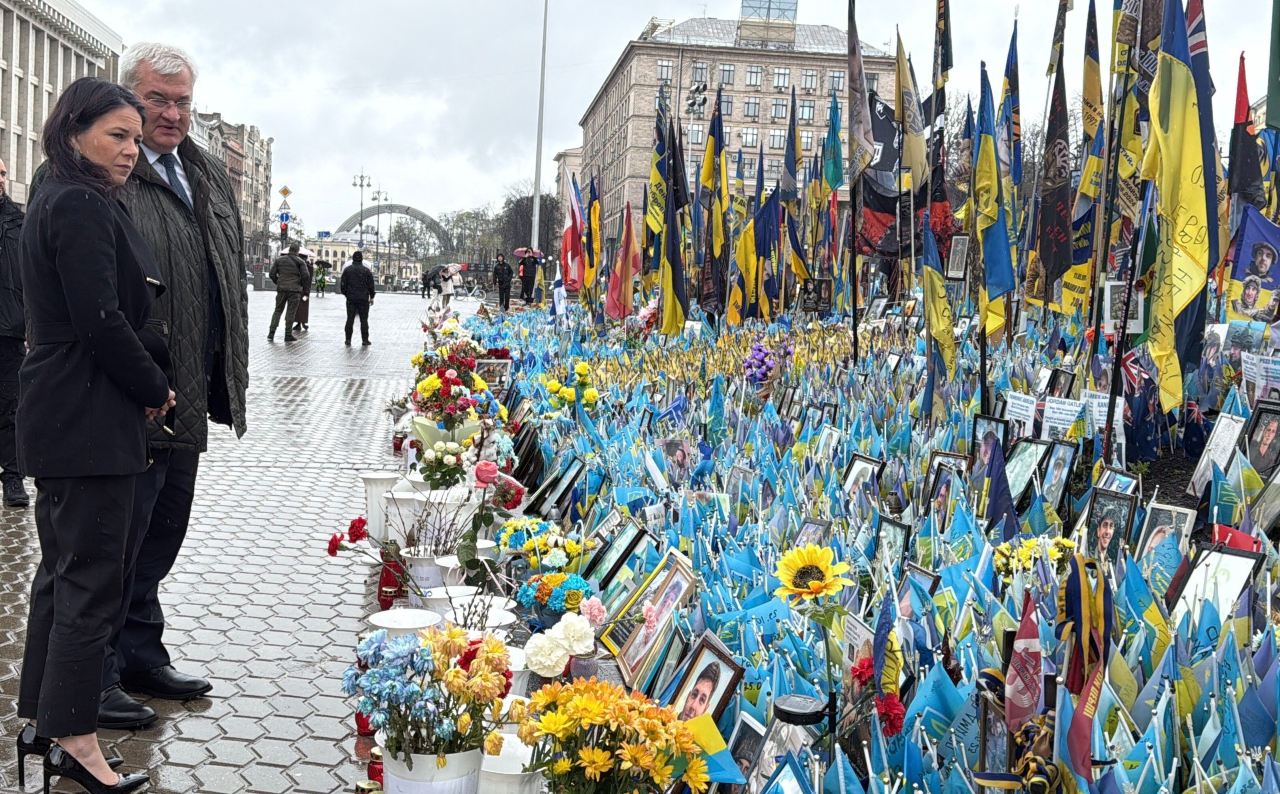
Foreign Minister Annalena Baerbock accused Russian President Vladimir Putin of stalling talks to halt the fighting in Ukraine, during a visit to Kyiv on Tuesday.
"He is manoeuvring his way out of negotiations, continuing his illegal war of aggression and escalating with brutal, threatening attacks on houses," Baerbock said at a press conference with her Ukrainian counterpart.
"Putin cannot be trusted in this situation," she said. "There will only be a real and lasting peace when the Russian president realises that he cannot win this war, that his destruction is not successful."
On March 11th, Ukraine, whose army is struggling on the front line, agreed with the United States a plan for a 30-day ceasefire with Russia.
But Putin has rejected the US proposal and upped his rhetoric on Moscow wanting to install new leadership in Ukraine.
READ ALSO: Berlin urges Russia to agree to ceasefire in Ukraine without conditions
Baerbock was visiting Kyiv for the first time since the re-election of US President Donald Trump, who has upended US-Europe relations by reaching out to Russia over European heads to seek an end to the conflict.
Berlin immigration authority aims to deport Gaza War protesters
US-based news outlet, The Intercept, reported this week that Berlin authorities are pushing to deport four young foreign residents due to their involvement in pro-Palestine protests.
Reporters at The Intercept say that internal emails show that authorities in Berlin's immigration office attempted to block deportation hearings from moving forward but members of Berlin's interior ministry pushed forward with them anyway.
Deporting foreign residents who pose a danger to German society is not uncommon, but a lawyer representing two of the defendants says in this case no serious criminal charges have been brought.
Instead he suggests that it appears they are being persecuted solely based on their political actions.
Three of the defendants are EU citizens and one is a US citizen who identifies as trans who says they do not feel safe returning to the US now.
Their cases are drawing comparisons to the Trump administration's use of deportation orders to suppress social movements.
READ ALSO: Germany updates US travel advice after three citizens detained
Comments (1)