
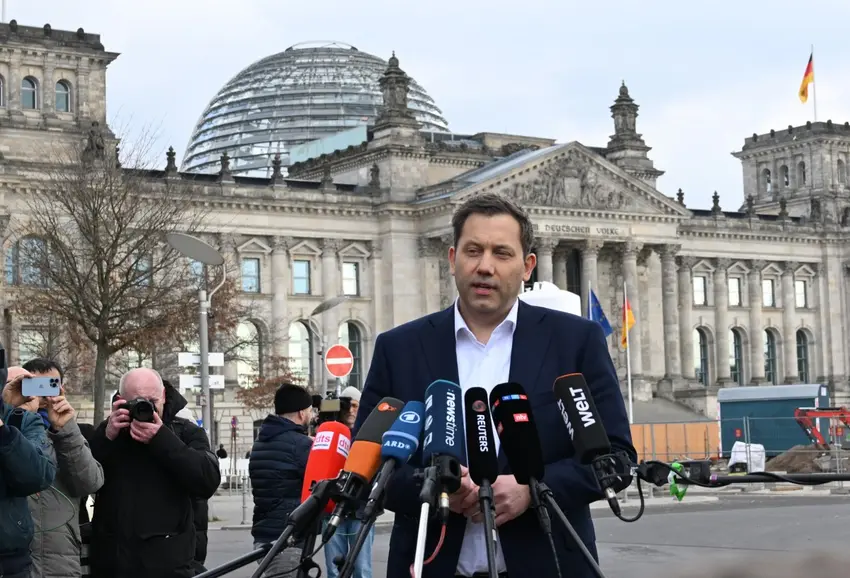
Budget committee recommends approval of finance package
The Bundestag's Budget Committee gave the green light to the CDU/CSU and SPD' multi-billion euro finance package on Sunday, recommending that parliament approve it and make the necessary amendments to the country's constitution.
"Today in the Budget Committee, we cleared the way for future investments," the Green Party's budget chief, Sven-Christian Kindler, told the DPA.
But the release of funds still depends on the decision of two votes: the Bundesrat on Tuesday and the Bundestag on Friday. Both require a two-thirds majority.
READ ALSO: Germany has ditched the debt brake, but what will the consequences be?
80,000 demand secure jobs at day of action across Germany
Over 80,000 people took part in a union day of action for secure industrial jobs in several cities across Germany on Saturday, according to union IG Metall.
Rallies took place in Hanover, Cologne, Frankfurt am Main, Stuttgart, and Leipzig.
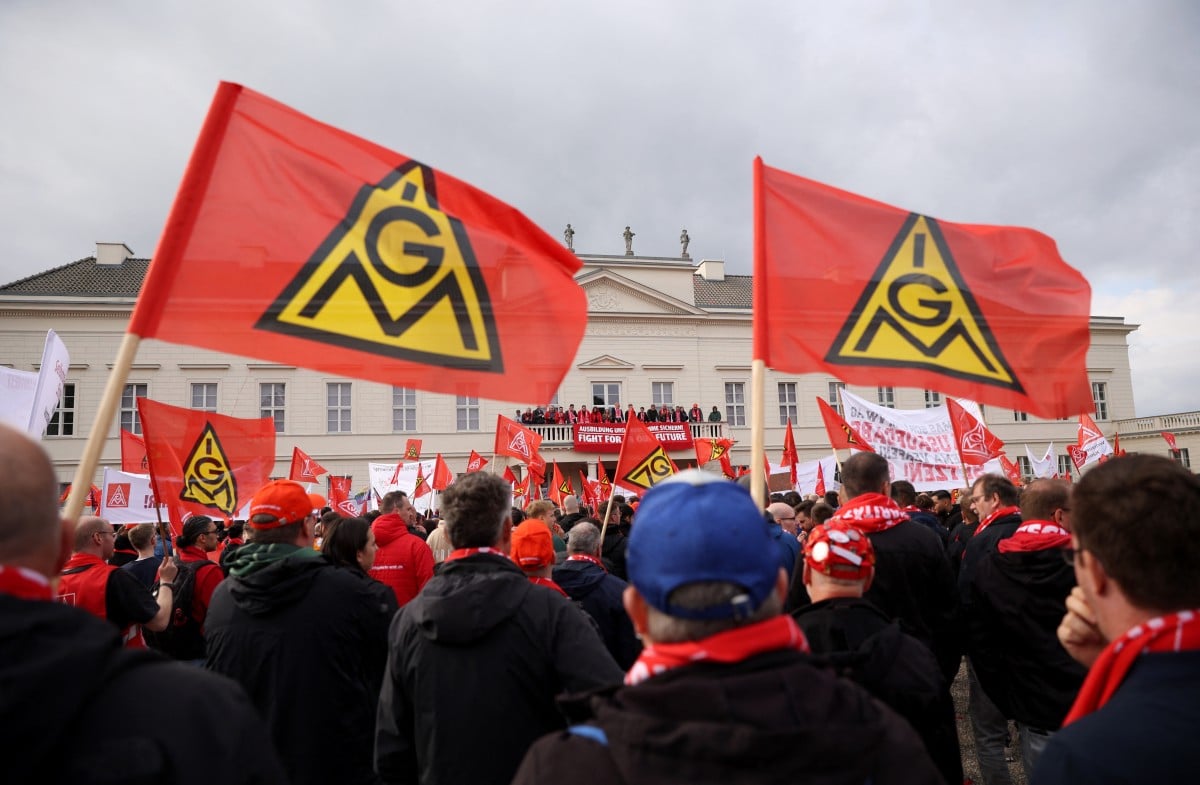
"With our day of action, we are sending a clear signal for swift action, bold investments by politicians and companies, and above all, for our future," said IG Metall chair Christiane Benner in Hanover, according to union information.
"Without industry, Germany is a poor country; we will not allow that," she said, accusing employers of only wanting to "cut back and relocate" but "making no effort to innovate or shape the future."
IG Metall is asking employers to commit to Germany as a business location, calling for an end to job cuts, site closures, and relocations.
German Pension Insurance Association pans planned mother's pension expansion
The CDU/CSU and SPD's plans to expand the mother's pension has come under sharp criticism from the head of the German Federal Pension Insurance Association, the Tagesspiegel reported on Saturday.
It would be a "very expensive redistribution," said the body's president, Gundula Roßbach, explaining that it would cost five billion euros per year.
The parties' exploratory paper does not contain any information on financing.
Roßbach also questioned the cost-benefit ratio of expanding the mother's pension: "We're talking about huge sums of money here because so many people are affected. Individuals receive around €20 per month, which is a lot for some, but not for others. But whether politicians want to spend so much money on this when it's sorely lacking elsewhere needs to be carefully considered," she said.
The Union and SPD's exploratory paper set out that three years of childcare time should now be credited towards the mother's pension, irrespective of when the child was born.
The parties also plan to include self-employed people in statutory pension insurance, which Roßbach said was "long overdue" with old-age poverty among the self-employed being a "major problem."
Peru farmer in German court battle with energy giant
A Peruvian farmer faces off in a German court Monday in a "David and Goliath" battle against an energy giant, demanding the firm pay for climate change damage.
Saul Luciano Lliuya, 44, argues that electricity producer RWE -- one of the world's top emitters of climate-altering carbon dioxide -- must share the cost of protecting his hometown Huaraz from a swollen glacier lake at risk of overflowing from melting snow and ice.
He wants the German company to pay €17,000 toward flood defences for his community, arguing that the fossil fuels the firm uses to generate electricity make it partly responsible for the flood risk.
"What I am asking is for the company to take responsibility for part of the construction costs," he said at a press conference in Lima earlier this month.

He first filed a lawsuit in 2015 but a court in the western German city of Essen, where RWE is headquartered, dismissed it the following year.
However, in 2017 a higher court in the city of Hamm, also in western Germany, allowed an appeal.
After a delay due to the Covid pandemic, hearings are scheduled from Monday to Wednesday, and Lliuya will be attending.
"I would never have thought that it would all take so long," Lliuya told Germanwatch, a German environmental NGO supporting him in the case.
Merz uses German air force more than any other Bundestag parliamentary leader
CDU head Friedrich Merz has used the Bundeswehr's air force 11 times in the last year, more than any other parliamentary leader in the Bundestag, Germany's editorial network (RND) reported.
All other parliamentary group leaders who are also entitled to use the air force did not use it at all last year, according to the report, which cited the government's response to a query from Left party MP Sören Pellmann.
A spokesperson for the CDU/CSU parliamentary group said Merz had used the air force "for a few trips to important European partners," while Merz' travel habits were criticised by Pellmann.
"Anyone who handles taxpayers' money so irresponsibly while in opposition and acts as a potential chancellor cannot be expected to do anything responsible for Germany in the future," the Left party politician said.
Poll shows majority accept lockdowns five years post-pandemic
Five years on from the Covid-19 pandemic that saw Germany impose tough nationwide lockdowns, a recent survey found that 56 percent of respondents still thought the restrictions had been the right thing.
Twenty-one percent of the 2,012 people polled said the lockdowns were completely correct and 35 percent said they were somewhat right, according to a poll carried out by YouGov for the DPA.
But 20 percent thought were completely wrong with a further 19 percent saying they were somewhat wrong.
READ ALSO: Merkel denies covering up German government report on Covid-19 origins
Fifty-six percent of those polled thought that lockdowns could be a necessary tool in the event of a new pandemic, while around a third generally rejected government intervention in everyday life during health crises.
Just under 275,000 on new organ donation register
Only 274,250 people are on Germany's organ donation register, one year on from its launch, the Ärzte Zeitung on Sunday, citing information from the Federal Institute for Drugs and Medical Devices (BfArM), which manages the register.
Individuals have to opt in to the register and, while the number of people signing up is gradually increasing, the growth curve is "far too flat," Green Party Bundestag member Armin Grau told the newspaper.
Grau highlighted several obstacles to registration, including the need for an ID card with online functionality and a smartphone or a PC with a card reader, calling for simplification and better promotion of the portal.
People can voluntarily declare in the register whether or not they wish to donate organs after their death and this entry can be changed or deleted later.
READ ALSO: What Germany's new digital organ donation register means for residents
With additional reporting from AFP and DPA
Comments