
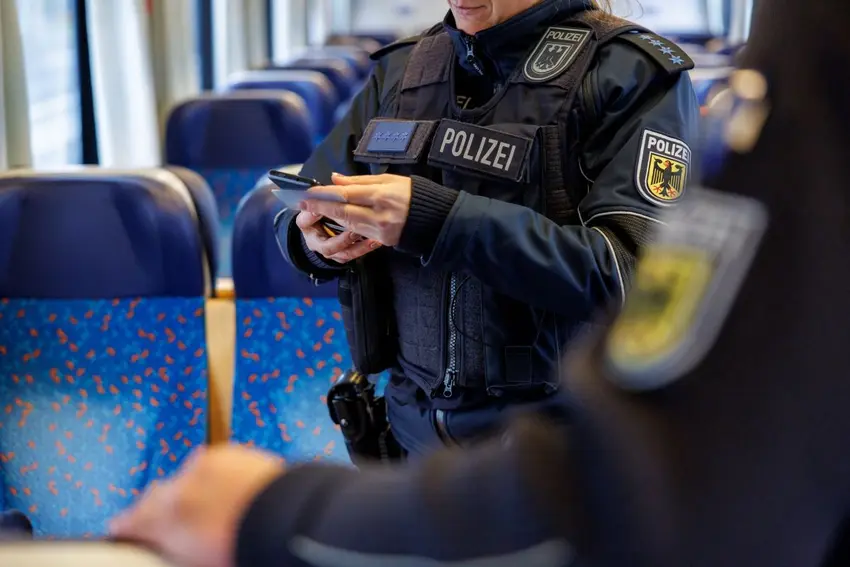
Since the introduction of stationary border controls last September, the federal police commissioner has received an increasing number of complaints from German residents who say they are unfairly being checked more often.
Federal police commissioner Uli Grötsch told the DPA that the number of formal complaints about unjustified checks on the basis of external characteristics - or alleged racial profiling - has "increased sharply".
Grötsch says he understands why people feel discriminated against. Some commuters with darker skin have reported being checked on ten out of twelve trips across the border.
As the federal police commissioner, Grötsch is tasked with helping to ensure that the federal police proceeds sensitively on this issue.
"No one should be checked just because they have a migration background or black skin," said Grötsch.
German law forbids police from checking people based on their skin colour - but, especially during border checks, many suspect that they do, and the rule is hard to enforce.
Complaints about racial profiling at border checks are not new
Karla Magazine, which covers the city of Constance on the Germany-Switzerland border, reported on alleged racial profiling at border checks in September of last year.
"The objective of border controls, namely the reduction of migration, reinforces the use of racial profiling," Samuel Hofer, member of the board of the Green party in the city of Constance, told the magazine.
"How else is this mandate supposed to be implemented by the federal police in practice?"
READ ALSO: EU paves way for states to set up controversial return hubs for migrants
Johannes Siegel, who is working on a doctoral thesis on racial profiling at the University of Constance, explained in the report that police get a lot of leeway when they conduct checks.
"It's difficult to prove [racial profiling] legally," ," he said. "You can't look into the heads of police officers."

In 2022, Left Party MP Clara Bünger asked a parliamentary question about racial profiling at the German-Czech border near Dresden.
She alleged that, "apparently without exception, people of colour and black people" have been checked on trains coming from Prague and then taken off trains in the Saxon capital.
Germany's Ministry of the Interior countered that federal police were "required to carry out the checks according to objective criteria" and that characteristics like skin colour or ethnicity were not considered.
However, there have been some documented cases where illegal profiling was proven - such as the 2022 case of Guinean man who was forcefully detained after refusing to cooperate with a police check in Chemnitz.
The Administrative Court of Dresden underlined the illegality of racial profiling in its ruling that the check and detention of the man was unlawful.
Controls at all land borders since September
Since September 16th, Germany's federal police have been carrying out checks at all of it's borders with France, Luxembourg, Belgium, the Netherlands and Denmark.
READ ALSO: How Germany's increased border checks will affect travel from neighbouring countries
Controls have been in place at the borders with Poland, the Czech Republic and Switzerland since mid-October 2023, and they were introduced at the German-Austrian land border in autumn 2015.
Not every single traveller is checked at the border sections, but everyone must expect to be controlled.
Foreign nationals who are travelling through, or near to, Germany's borders should carry both their residence permit and passport.
Long-term controls at Europe's internal borders are generally not supposed to take place within the Schengen area. However, they can be registered with the EU Commission and temporarily ordered if there is a terrorist threat, or for major events or to put a stop to smugglers and limit irregular migration.
Comments (2)