
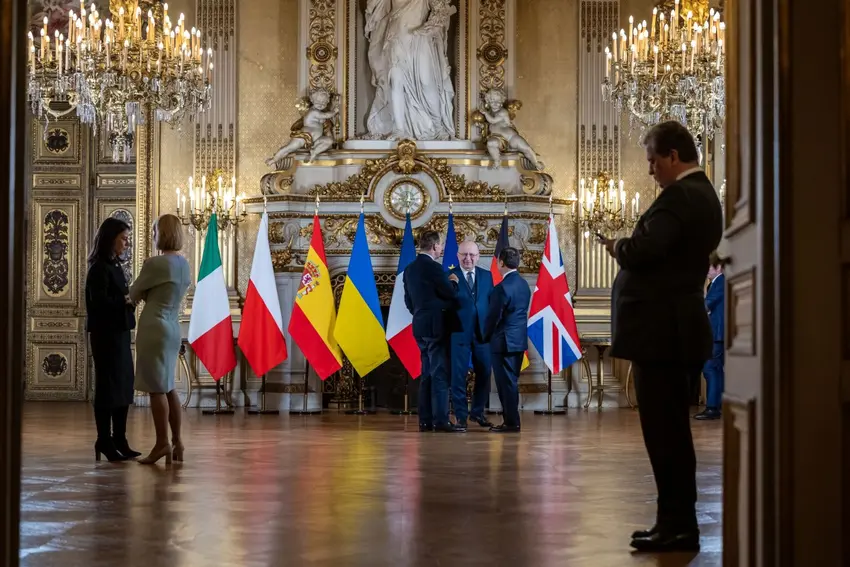
Lofty rhetoric and frank acknowledgements of a new world order have not been in short supply from European leaders since the new American administration of Donald Trump took office, making clear starkly different policy priorities.
Trump spoke over the heads of not only Europe but also Ukraine by declaring he was ready to negotiate with Russia to end the three-year war, while his Vice President JD Vance left seasoned policymakers dazed with a withering attack on the European Union at the Munich Security Forum.
The shock switch in policy from the United States has prompted calls for Europe to ramp up its own defence capacities through higher spending and even to consider sending troops to Ukraine to enforce an eventual ceasefire.
Emergency talks of key European leaders called Monday by French President Emmanuel Macron were aimed at showing a united front, but immediately exposed tensions with German Chancellor Olaf Scholz saying he was "a little irritated" by suggestions, from the likes of British Prime Minister Keir Starmer, that troops should be deployed.
In the most concrete sign that the United States has brought Russia back from the cold, Russian Foreign Minister Sergei Lavrov was to hold talks with American counterpart Marco Rubio in Saudi Arabia later Tuesday.
Polish Prime Minister Donald Tusk told reporters in Paris: "Everyone at this meeting is aware that transatlantic relations, the Nato alliance and our friendship with the United States have entered a new phase."
Nato chief Mark Rutte said the Europeans were "ready and willing" to step up, while EU commission chief Ursula von der Leyen called for a "surge" in defence.
'Clock is ticking'
The chairman of the Munich Security Forum Christoph Heusgen, after the annual conference was shocked by Vance's speech, went as far as to say: "We have to fear that our common-value base is not that common anymore".
As if to emphasise his point, some accounts on social media edited his speech to show him weeping when he said this, although in fact his emotion came after he thanked his team over his last year in charge.
"This unfortunately shows again how the mechanisms of disinformation work," Heusgen later said on social media.
Phillips O'Brien, professor of strategic studies at the University of St Andrews, said that while the west is "perilously close to the worst-case scenario on Trump and Ukraine", Europe should have seen the trouble coming.
"The European reaction seemed stunned – which is just as worrying," he said.
"Europe should have been preparing some kind of response for over a year. However, European leaderships seem to have wilfully stuck their heads in the sand, and been living on hopes and dreams that Trump would be what he was not."
For Alberto Alemanno, professor of EU law at the HEC Paris business school, the Paris meeting showed "major differences" among European countries over committing peacekeeping troops to Ukraine and funding a massive defence investment push.
"At least the debate is now in full swing across capitals and beyond but the clock is ticking," he said.
'Question of political will'
Latvian President Edgars Rinkevics, whose country shares a border with Russia, said that since the Russian invasion of Ukraine in February 2022, there had been much talk in Europe about increasing defence spending, but "our capabilities are not enough".
"I'm afraid that, after a couple of days, after strong statements, we will somehow relax again, and we will go back to business as usual," he said after the Munich meeting.
While the informal Paris talks were not aimed at forging an agreement, many leaders agreed that one key step for the European Union was to relax its strict fiscal rules to allow higher defence spending by member states.
"I expect that when we meet in the European Council next time, we will have an agreement about the fiscal rules and the way forward ensuring that all member states can actually lift our expenditures on defence," said Danish Prime Minister Mette Frederiksen.
For former Lithuanian foreign minister Gabrielius Landsbergis, who was present in Munich, the United States is "no longer happy to be the main guarantor of security in Europe" and "does not see the EU as it once did".
"Europe is technically fully able to adapt and rise to this challenge, but the question remains one of political will, or the lack of it. Indecision will lead in only one direction, and it won't be pretty."
Comments (4)