

If you’re travelling around Germany (or through Germany and beyond) on trains, your journey will most likely involve a transfer or two.
Journeys between major cities – e.g. from Hamburg to Munich – can be made with one direct connection. But traveling to or from smaller cities may involve switching between long-distance and regional trains at a station along the way. International journeys also often involve transferring from a Deutsche Bahn (DB) train to another national railway’s train near the border.
For convenience, multiple connections can be bought together under a single ticket in the DB app. But given the regularity of delays on the German railways, it’s not uncommon that a second or third connection on a long train journey is missed.
Fortunately, DB’s passenger rights ensure that in these cases you wont be left without a ticket to ride – and in some cases you may also be entitled to compensation.
Why you should buy the multi-transfer ticket
In a recent post on Reddit’s ‘Germany’ topic page, a user shared a screenshot of a potential train ticket – from Stuttgart to Vienna with a transfer in Munich’s central station. With only 18 minutes given to transfer trains in Munich's Hauptbahnhof, they asked “Should I trust Deutsche Bahn?”
Quite a few commenters responded to the question with an emphatic “No!” – one went as far as writing out, “NEVER. TRUST. DEUTSCHE. BAHN.”
While those tongue in cheek comments are worth a chuckle (and were most certainly inspired by some real negative DB experiences) the more helpful answer is quite the opposite: if you miss your train because of a delay on an earlier train, your ticket effectively becomes a flexible ticket, allowing you to take any other DB train at no extra cost.
In short, when you buy multi-transfer tickets with DB, you CAN trust the ticket to get you to your destination. But whether you arrive by the originally suggested arrival time is another story.
READ ALSO: 'Four-hour delays' - How travelling on German trains has become a nightmare for foreigners
How does it work?
According to DB’s passenger rights policy: “In the event of an expected delay…of at least 20 minutes for national journeys, or at least 60 minutes for international journeys…you can continue the journey at the next opportunity on the same route or on a different route.”
What this means in practice is that when your transfer is missed due to DB delay, there is no need to buy a new ticket to continue your journey. Simply board the next train going to your destination (including trains on different routes that lead to your destination if necessary).
DB’s staff are used to this and will usually accept your original ticket without question if you are checked on subsequent trains.
You are also entitled to postpone your journey, if it makes more sense to continue your same journey at a later time.
And you can switch to other trains as needed. For example, your ticket for an IC/EC or ICE train, would also be valid on a regional train if it helps you get to your next transfer point or destination.
But note that to switch the other way, i.e. to ride an IC/EC or ICE train after your regional train was delayed, DB says you should buy an additional ticket, and then have it refunded by the Passenger Rights Service Centre.
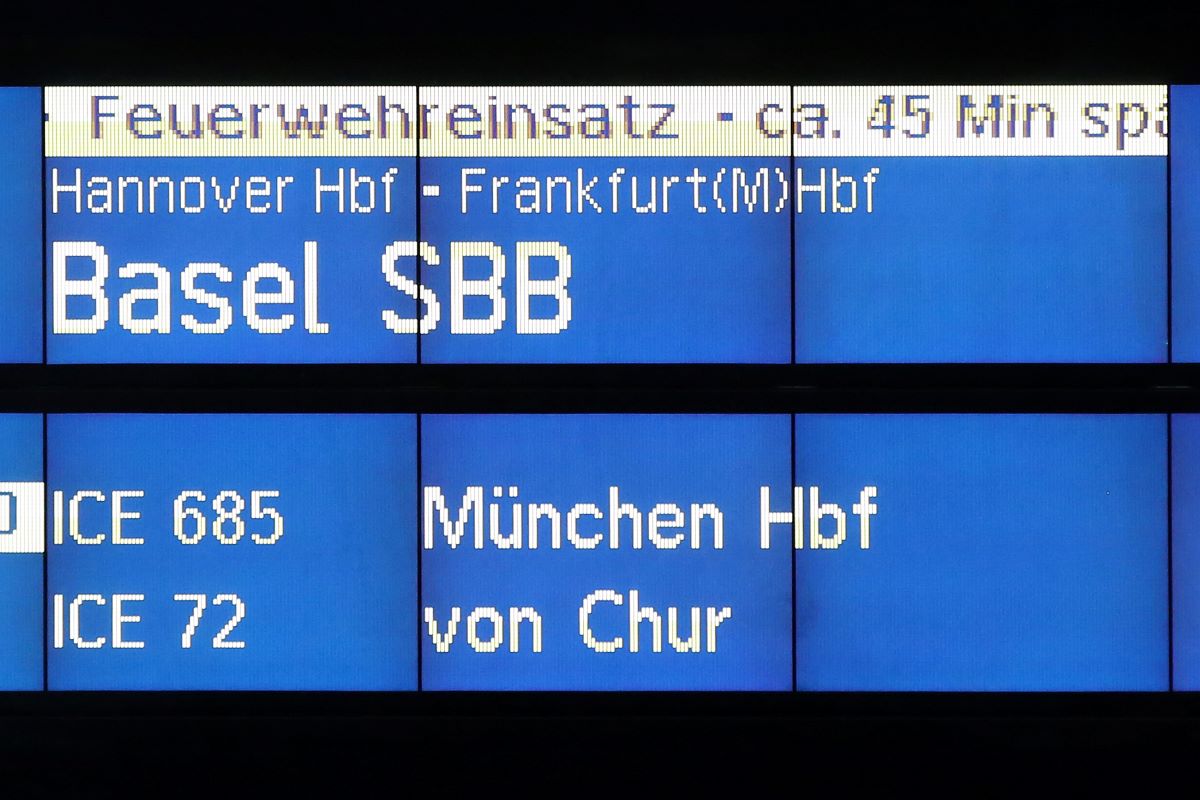
In the event that a delay of 60 minutes or more is expected at your destination station, and you’d rather not continue on your train journey, you can also have your ticket cancelled and refunded.
If this occurs after you’ve travelled part of the route, you can have the unused portion of the ticket refunded. But this would, of course, void your ticket from being used on further trains.
READ ALSO: Why has German train punctuality got so bad?
When are you entitled to compensation?
In the event of severe delays, DB will also compensate you for a portion of the ticket price.
According to DB’s policy, you’re entitled to compensation worth 25 percent of the one-way ticket price when arrival at your destination is delayed by 60 minutes or more. For delays of 120 minutes or more, you’re entitled to 50 percent of the one-way ticket price.
This compensation can be paid out either in cash or in the form of a voucher for future travel.
You may also be entitled to compensation if you’re travelling with the use of certain longer-term tickets, like weekly or monthly travel passes, the BahnCard 100, or the Quer-durchs-Land-Ticket. In this case, DB sets a flat rate for compensation depending on the ticket you have.
Note that if you’re travelling regularly, you may add up each delay of 20 minutes or more and submit them collectively in a compensation claim.
You can also seek reimbursement for travel or accommodation costs when your travel is severely disrupted due to delays.
For example, if your train is suddenly cancelled and you need to use a bus or taxi to reach your destination, DB may be on the hook to reimburse those costs. This applies when an arrival scheduled between the hours of midnight and 5am is delayed by an hour or more, or when a train cancellation leaves you unable to reach your destination before midnight.
In these cases DB will reimburse other transport costs up to a maximum of €120.
In some cases DB will also reimburse hotel or overnight accommodation costs. DB’s policy says this applies when “it is not reasonable to continue the journey on the same day”. In this case, you’d be advised to contact DB’s information line, or speak with personnel on your train or at the station, before booking a room that you expect to be reimbursed.
How long do I have to submit my claims?
According to an EU regulation, passengers have at least three months to submit reimbursement claims.
However, DB says on its website that it will continue to accept and process complaints based on its previous 12 month deadline until further notice.
Still they ask customers to adhere to the three month period if possible.
What about international journeys?
Fortunately for international train travellers, many of the passenger rights outlined above also apply to journeys that cross state lines.
Sixteen major European rail operators have arranged an “Agreement on Journey Continuation”, which allows you to continue on your international journey when connecting trains are missed. So if you miss a connection to a French SCNF train, for example, you can simply hop on the next one, even if the delay was the fault of DB.
The participating rail operators are: BLS (Switzerland), CD (Czech Republic), CFL (Luxembourg), DB (Germany), DSB (Denmark), GYSEV and MÁV-START (Hungary), NS (Netherlands), ÖBB (Austria), PKP (Poland), Renfe (Spain), SBB/CFF (Switzerland), SJ (Sweden), SNCB/NMBS (Belgium), SNCF (France), SZ (Slovenia), Trenitalia (Italy), ZSSK (Slovakia).
This is based on a good faith agreement - technically there is no legal entitlement for passengers in place.
Additionally, international travellers may be entitled to compensation from DB for delays of 60 minutes or more, as is mentioned above.
READ ALSO: The ski destinations you can reach by train from Germany
Comments