

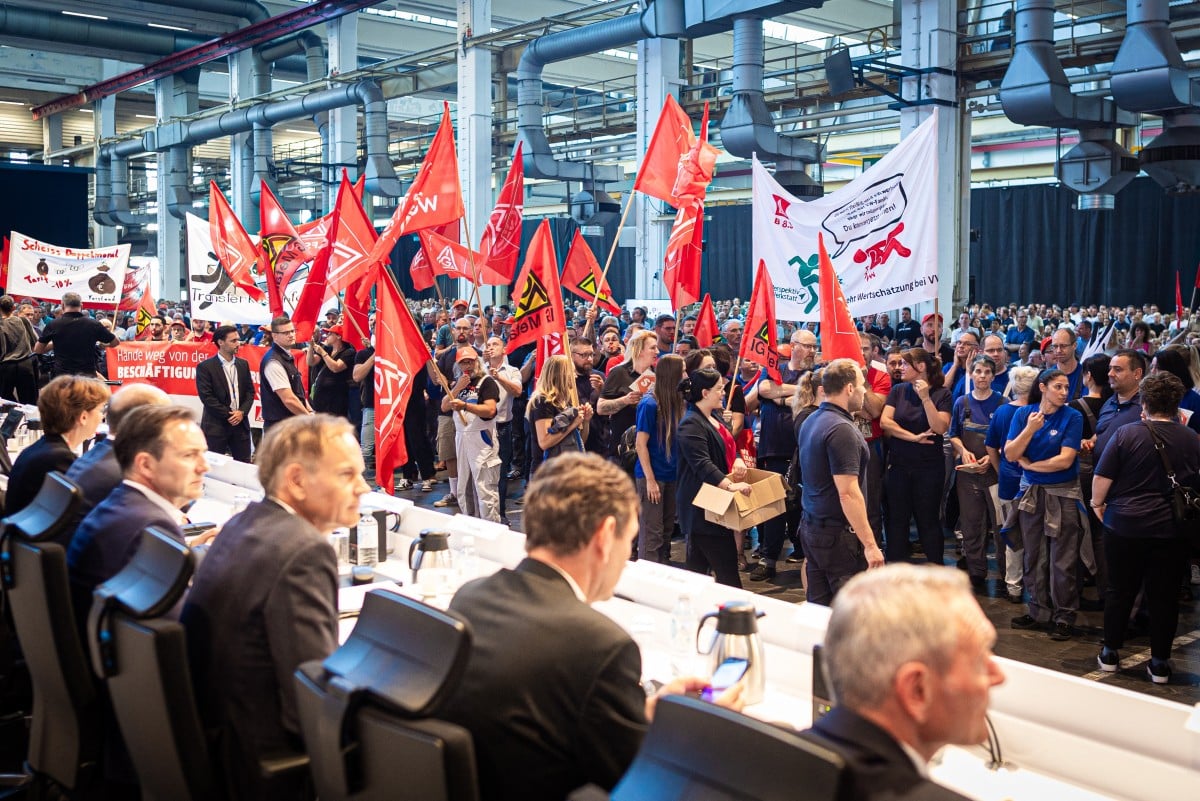
Economists, politicians and workers alike have been watching German carmaker Volkswagen closely this week following news that the company plans to close factories in Germany and cut jobs to boost its profit margin following a slump in sales.
VW has not said how many jobs are at risk, but a German media report last week cited sources that claimed up to 30,000 positions could be cut in the coming years. Representatives of both VW and its workers council are set to begin talks on the topic in Hanover on Wednesday.
But VW is not the only legacy automaker facing challenges. In fact many of Germany’s leading firms are suffering from the combination of high manufacturing costs, weakening demand, and increased competition in the international markets. Many German automakers have also been criticised for waiting too long to ramp up their production of EVs.
The news about potential layoffs comes amid a wave of bad economic news in Germany, and warnings that the country may be on the verge of a recession.
The Local takes a look at how Germany's car crisis may affect employment more broadly in the country.
How many jobs are on the line?
According to Statista, about 780,000 people worked in Germany’s automotive industry in 2023. That number has been declining slowly since 2018 when there were about 834,000 employed workers in the industry.
Carsten Brzeski, global head of macro analysis at European bank ING, suggests that when you add in sub-contractors and suppliers, and account for the fact that local economies in some regions are effectively dependent on the automotive industry, "you quickly come up with 1.2 to 1.4 million jobs" in Germany.
“Of course, not all of these jobs will disappear and certainly not overnight,” Brzeski told The Local, adding, “That's why there are labour laws in Germany. In this case they ensure that possible job losses would be gradual.”
READ ALSO: German union vows 'bitter resistance' as Volkswagen talks begin
Dr. Enzo Weber, Head of Forecasts and Macroeconomics at Germany's Institute or Employment Research (IAB), notes that while larger automakers may ultimately adapt to changes in the market, it's their smaller parts suppliers that are at risk more immediately.
"Volkswagen can switch to producing electrical cars, but a small firm with 100 employees that produces screws for combustion motors, they are really facing problems," Weber told The Local.
He added that these types of suppliers have historically offered a large number of good, high-paying jobs in Germany, but they seem to be facing challenges across the country now.
Is unemployment on the rise?
The situation at Volkswagen is in the spotlight at the moment. But what’s worrisome in the bigger picture is that the possible layoffs at VW could be foreshadowing an increase in unemployment across multiple sectors in Germany.
According to recent figures from Germany’s statistical office (Destatis), 1.65 million people were unemployed in July 2024, representing an increase of 346,000, or 26.5 percent since the previous year.
“I'm not making any predictions about how bad it could get,” Brzeski said. “We simply still know too little for that.”
The IAB maintains a ‘Labour Market Barometer’ based on a monthly survey of local employment agencies across Germany and Europe. According to the IAB's barometer, Germany’s employment forecast has fallen to its lowest level since the Covid crisis.
That said, Weber notes that "we still have a record employment in Germany". The issue is that certain sectors - namely manufacturing, construction and retail - are shrinking.
Ultimately Germany’s auto industry is caught in the middle of transformations in both domestic and global markets. And the auto industry's interconnectivity to the country's broader manufacturing industry means that job losses there could trigger job losses elsewhere.
The only feasible answer there is “long-term investment and reforms”, Brzeski suggests.
For his part, Weber suggests that Germany's labour market policy needs to focus on "further developing those guys on the old jobs towards the new areas, like on hydrogen fuel applications in the auto industry, for example".
How long could an unemployment wave last?
From Brzeski’s point of view, there would be nothing particularly surprising about a further wave of layoffs at this point.
“After four years of economic stagnation, it’s 'normal' for the labour market to slow down,” he said, adding that he could foresee a further increase in job cuts across German industries in the coming months.
“The rise in unemployment is likely to continue until the end of 2025 due to job cutbacks and ongoing economic weakness,” he predicted.
Comments