
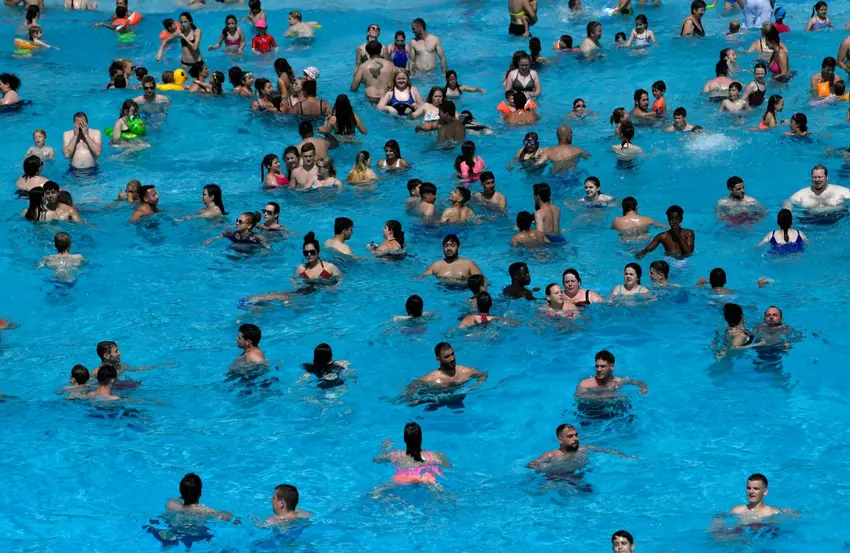
Legal wrangles in Germany have confirmed a woman's right to topless bathing, but few appear in a hurry to embrace the breakthrough just yet.
"I don't feel ready for it at the moment, but I am working on it," said physiotherapist Martina Parsch, 45, relaxing in the sun at a Frankfurt outdoor swimming pool.
Frankfurt is among a host of German cities which have recently announced women can enjoy a dip in their public pools without a top, following a high-profile legal dispute in Berlin.
At the end of it, pool operators declared that, in line with anti-discrimination rules, all genders must be treated equally when it comes to exposing their breasts.
But, like Parsch, many appear reluctant to do so, in a sign of shifting social mores in a country once known as a centre for naturism and nude public bathing.
One topless swimming enthusiast in Frankfurt, who gave her name only as Muriel, was delighted the rules had "at last" been changed.
But she conceded she had only seen two other topless bathers at the outdoor pool she frequents.
Berlin residents also say the practice is not widespread there.
READ ALSO: Topless swimming fails to take off at Hamburg's public pools
The lack of enthusiasm is a sign that naturism -- popular among past generations in Germany where it is known as "Freikoerperkultur" (FKK), or free body culture -- may be losing its appeal for younger generations.
Membership of the Freikoerperkultur federation has halved from its peak while several opinion polls show that a majority of German women are opposed to topless swimming.
"The female body is linked to projections and fears," said Anja Zimmermann, a professor at the university in Erlangen, who has written about the history of the breast.
The breasts of older women or those not considered normal are "taboo", and "portrayed in texts and images in a repulsive way", she said.
'Raise people's awareness'
The move to allow topless swimming does have many supporters, however -- even among those who don't indulge in it themselves.
Bianca Polcar, a 53-year-old saleswoman who used to go to naturist beaches in her youth, said nudity allows young girls to "love their bodies as they are".
This was especially true in an era in which "idealised images" frequently circulate on social media, she said.
The drive to allow topless swimming began in the central city of Goettingen in 2022 after a bare-chested person who said they were non-binary was refused access to a swimming pool.
When the city's pools changed their rules, the management said they had to deal with the "extreme" camps for and against the changes.
"It's a public space that welcomes different interest groups and different mentalities," one manager was cited as saying in the media.
In 2023, Berlin authorities clarified topless bathing was allowed after a woman launched a legal fight when police asked her to cover up or leave the public water park where she was sunbathing.
Her case was initially rejected, but she was awarded compensation at the end of 2023.
Other cities, including Frankfurt and Cologne, then followed suit and clarified their regulations to recognise the right to swim topless.
In some places, such as Hamburg, bare breasts are permitted on certain days of the week.
The case in Berlin "raised people's awareness and showed them what was possible", says Soraia Da Costa Batista of the Society for Civil Rights, an NGO that supported the plaintiff.
Comments