
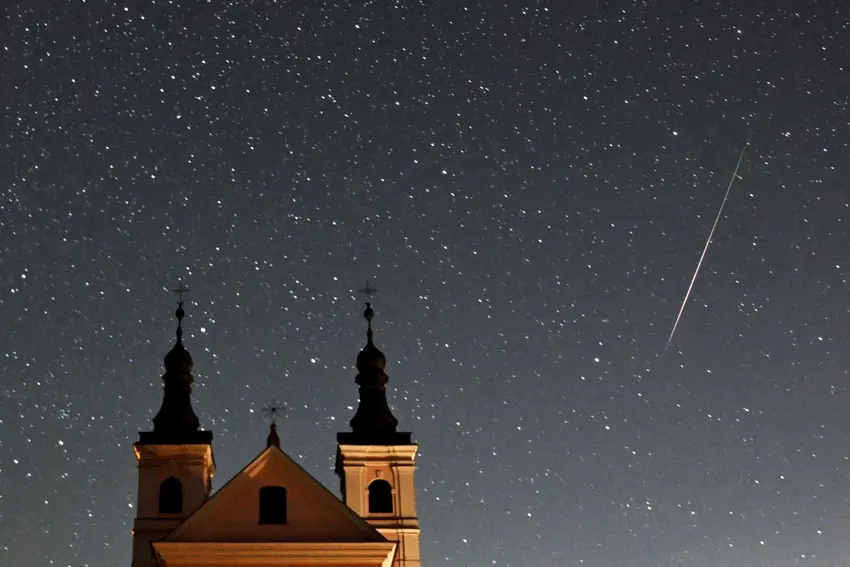
If you've been looking for a chance to wish upon a shooting star, all you need to do is find a dark place outside tonight and look up.
The Perseid meteor shower is visible over Germany and the northern hemisphere from mid-July to late-August and peaks on the night of August 12th.
Seen from earth's surface, stargazers can expect to see up to 60 shooting stars per hour.
Meteors are chunks of rock often left behind by larger comets, and shooting stars - known to astronomers as meteorites - are meteors that enter earth's atmosphere.
This year's shower is expected to peak on Tuesday night into the early hours of Wednesday.
Unfortunately, this year shooting stars will be partially obscured by the bright light of the still almost full moon. According to the observatory in Rodewisch, Saxony, the moon will be in an unfavourable position on Tuesday evening.
That said, a mostly clear and warm night in much of Germany offers stargazers otherwise good conditions to get out and see a spectacular star show.
The best way to see the meteor shower
To maximize your chances of seeing a meteorite, you'll want to turn your attention to the sky sometime between 11pm and 4am.
Similar to stars, the darker the sky, the more meteors you can see. So you'll find the best view away from big cities that produce a lot of light pollution.
The most ideal viewing location would be anywhere in nature - a fair distance away from large light sources - with a wide-open view of the night sky.
For example, residents of west Brandenburg and Saxony-Anhalt could consider a trip to Sternenpark Westhavelland - a "star park" which is intentionally protected from light pollution to allow for prime star gazing.
READ ALSO: Five of the best camping regions in Germany
If you are well-positioned, you can catch sight of a few meteorites by simply standing outside looking upward for a few minutes. But if you want to make a night of it, you could bring a blanket to sit on and some midnight snacks to a wide open field or hilltop.
The Perseids can be seen across the night sky in the northern hemisphere, but to see the most of them from Germany, you'll want to face northeast. Perseid meteors can appear anywhere in the sky, but their path tends to appear from a point near to the constellation Perseus – which is why they are so named.
If you're not familiar with Perseus, you could use a a star chart or star gazing app to find it.
Other meteor incidents in Germany
The Perseids come from the so-called Swift-Tuttle comet, which last passed near earth's orbit in the early 1990s.
Many of the Perseid meteors are travelling at speeds as high as 60 kilometres per second when they pass by the earth.
Most of the time meteorites burn up in the upper layers of the atmosphere long before they have a chance to collide with earth's solid surface. However there have been a few infamous meteorite strikes in Germany in recent years.
In 2023, residents of Elmshorn, Schleswig-Holstein called the fire department after hearing a loud bang and finding a small stone in their yard. The roof of a nearby home was also damaged.
A couple of days later the German Aerospace Center (DLR) determined the stone was a meteorite. The DLR estimated that the meteor had weighed over 100 kilograms before entering the atmosphere and had been in space for around 4.5 billion years.
READ ALSO: Meteor causes scare in southern Germany
Two decades prior, larger pieces of a meteorite struck ground not far from the Neuschwanstein Castle in Bavaria. The meteor was observed by many people around central Europe, with local residents reporting loud rumbling noises and rattling windows as far as 100 kilometres away.
Comments