

On Tuesday, November 11th 2025, people across Germany and other parts of Europe will mark St Martin's Day.
Martinstag, as it is known in German, is named after St Martin of Tours, a Roman soldier who became a monk after being baptised as an adult. He was eventually made a saint by the Catholic Church for being a kind man who cut his cloak in half to share with a beggar during a snowstorm.
What do the lanterns mean?
In many parts of Germany it is traditional for children to participate in a procession of paper lanterns in remembrance of Sankt Martin. They make their own little lanterns in school or kindergarten - or their parents buy them in shops like DM or a supermarket. They then gather on streets in a procession to sing songs about St Martin and their lanterns.
Often a man dressed as St Martin with a long red cloak leads the parade. In some areas (but probably not in cities) this may even be on horseback.
Officially its a Catholic holiday, but in recent years the lantern processions have become widespread even in Protestant areas of Germany. So just like Santa Claus has little to do with the birth of Christ, these days St Martin Day's is probably better known for the luminous procession than the saintly history.
How to celebrate St Martin’s Day
If you have kids, you’ll probably spend the evening outside with a bunch of other parents and their children.
You’ll be busy relighting the tea candles in those fiddly little lanterns with cold, stiff fingers, and drying off children's tears because, as upsetting it is for the kids, paper lanterns lit by candles tend to catch fire quite quickly. Who would have thought...
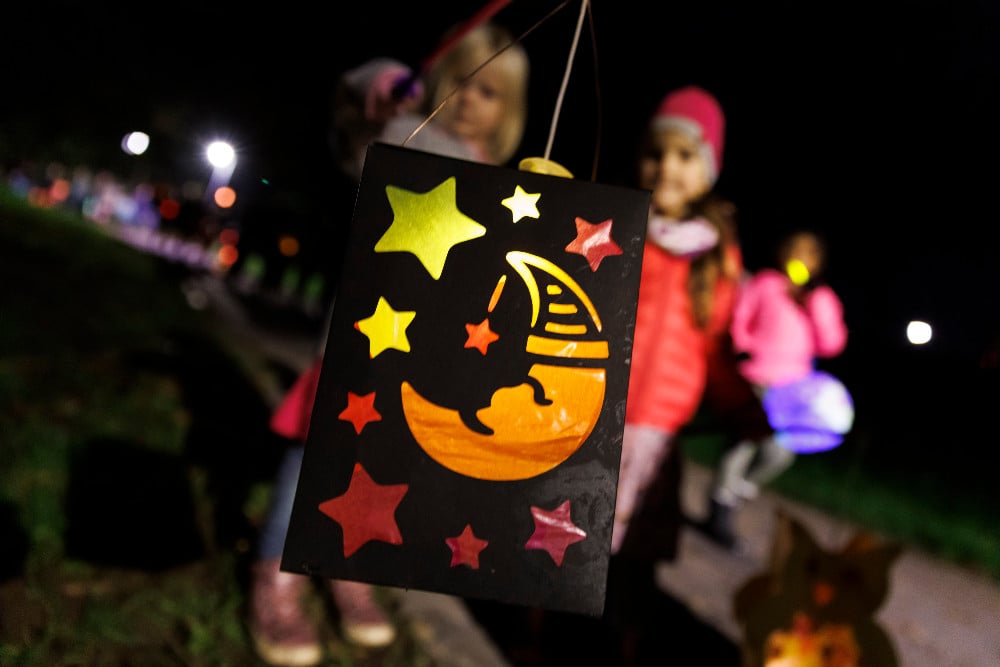
Heavens! That sounds dangerous.
Well, definitely worrying for the parents, forced to prevent their little ones from accidentally setting each other on fire during the procession. But on the other hand, it wouldn’t really be a proper St Martin’s procession without someone stamping out a flaming lantern, or a sad-faced child clutching to a charred stick.
By the way, nowadays some lanterns have LED lights to avoid actual fire so perhaps that's some comfort.
What do I do if I don’t have children? Is there anything else to it?
Like most holidays, St. Martin's Day is also about eating food. The traditional go-to snacks are goose with red cabbage and dumplings, which will definitely will fill you up on what is often a cold day.
The origin of the meal go back to a legend in which Martin was reluctant to become a bishop as an honour for all his good deeds, so he hid in a stable filled with geese to escape from Church officials.
Martin might have been a very kind and gentle man, but he apparently wasn’t the smartest. Otherwise he would have considered a better hiding place than a pen filled with gabbling geese - who ended up giving away his location.
Perhaps the more likely reason is that November 11th is the beginning of Advent fasting, so devout Catholics get a last chance to feast before they abstain from greasy food and booze until Christmas.
And if I am not Catholic, don’t like goose and have no children?
Then you might want to huddle around one of the many Martin bonfires, eat something else or simply celebrate the beginning of carnival, as it starts on November 11th as well.
READ ALSO: What you need to know about celebrating carnival in Germany
Comments